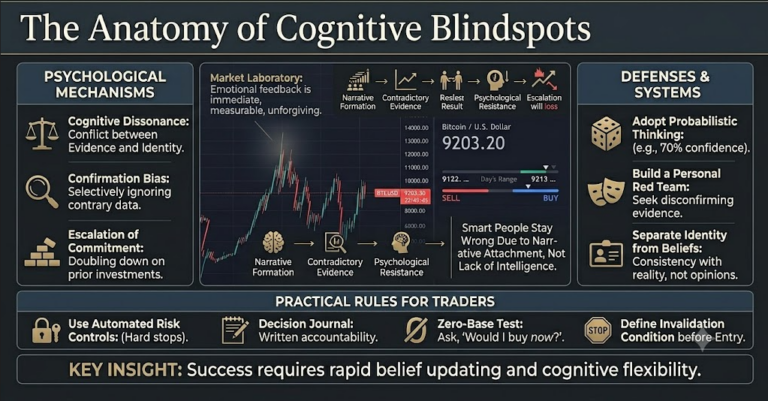
The Anatomy of Cognitive Blindspots
This article explores the psychological, neurological, and behavioral mechanisms that contribute to cognitive blindspots and self-justification. Drawing from cognitive dissonance theory, confirmation bias, escalation of commitment, and contemporary neuroscience, it examines why individuals frequently resist updating beliefs when confronted with contradictory evidence. Particular emphasis is placed on financial markets, where these tendencies become highly visible through trading behavior and risk management failures. The article argues that the central challenge is not a lack of intelligence but an attachment to existing narratives and identities. To mitigate these effects, it proposes practical frameworks including probabilistic thinking, adversarial analysis, identity separation, predefined invalidation criteria, and systematic decision documentation. Ultimately, the article presents cognitive adaptability—not certainty—as the cornerstone of effective decision-making in both markets and life.