Author: Jayesh Rawal

  • The Great Global Re-balancing

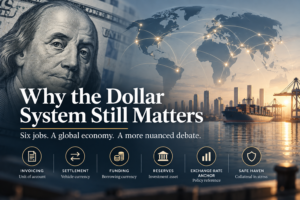
    The Great Global Re-balancing: Beyond the Dollar System explains that the world is not witnessing an immediate collapse of the dollar system, but a gradual shift toward a more diversified global order in which countries build additional options in reserves, payments, trade routes, energy, infrastructure, institutions, and diplomacy. The article uses the Adaptive Polycentric Framework (APF) to show how monetary, financial, institutional, physical infrastructure, energy, resource, and geopolitical layers interact as states seek resilience against debt pressure, sanctions risk, supply-chain shocks, and geopolitical uncertainty. It emphasizes that middle powers such as India, the UAE, Saudi Arabia, Türkiye, Indonesia, Brazil, and Singapore act as “adaptive nodes” connecting multiple systems rather than choosing one rigid bloc. The 5–10 year outlook is balanced: the dollar likely remains central, but local-currency settlement, gold reserves, CBDCs, regional institutions, energy flexibility, and trade corridors are expected to become more important parts of a layered global system.

  • Sanatan Dharma: A Philosophical Reflection on Dharma, Karma, Natural Order, and Harmonious Living

    This article presents Sanatan Dharma as an eternal philosophy of rightful alignment, where Dharma is not merely goodness but the sustaining law of balance, justice, responsibility, and consequence. Through the symbolic lens of Sana–Tan–Dharma, it reflects on the Dharma of matter, nature, human action, society, and consciousness, while linking Dharma with Karma as the law of action and response. It emphasizes that Sanatan Dharma is a living framework of wisdom, capable of holding peace and power, compassion and correction, unity and diversity, without reducing itself to ritual, dogma, or forced scientific claims. Ultimately, it portrays Sanatan Dharma as a path for cultivating awareness, disciplined action, inner awakening, social harmony, and reverence for the interconnected order of existence.

  • The Anatomy of Cognitive Blindspots

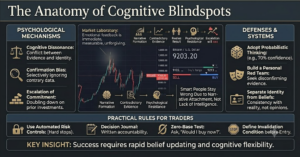
    This article explores the psychological, neurological, and behavioral mechanisms that contribute to cognitive blindspots and self-justification. Drawing from cognitive dissonance theory, confirmation bias, escalation of commitment, and contemporary neuroscience, it examines why individuals frequently resist updating beliefs when confronted with contradictory evidence. Particular emphasis is placed on financial markets, where these tendencies become highly visible through trading behavior and risk management failures. The article argues that the central challenge is not a lack of intelligence but an attachment to existing narratives and identities. To mitigate these effects, it proposes practical frameworks including probabilistic thinking, adversarial analysis, identity separation, predefined invalidation criteria, and systematic decision documentation. Ultimately, the article presents cognitive adaptability—not certainty—as the cornerstone of effective decision-making in both markets and life.

  • Zepto IPO Review: Hypergrowth, Operational Innovation, and the Long Road to Sustainable Profitability

    Zepto’s IPO is one of the most significant consumer internet listings India has seen in recent years. The company has grown revenue from ₹4,454 crore in FY24 to ₹22,624 crore in FY26 while establishing itself as a leading quick-commerce platform. The investment debate, however, is no longer about growth. The central question is whether quick commerce can become a sustainably profitable business before competition from well-capitalized incumbents intensifies. This review examines Zepto’s growth story, ownership structure, operational strengths, profitability thesis, and the critical unanswered questions that investors should consider before participating in the IPO.

  • The Multipolar Sanctuary: Capital Realignment and Wealth Preservation Across the UAE-India Geopolitical Axis

    This master thesis investigates how skyrocketing Western sovereign debt, NATO budget exhaustion from regional proxy conflicts, and East Asian supply-chain risks are actively fracturing the US dollar’s status as the global reserve currency. It deconstructs the historic surge in global gold prices and unprecedented central bank accumulation as silent, sovereign actions taken by non-aligned nations to aggressively de-risk their wealth without publicly telegraphing a loss of confidence in Washington. Ultimately, the paper demonstrates how global capital can bypass weaponized banking systems by routing through parallel BRICS payment infrastructure (BRICS Pay and Project mBridge) into secure UAE common-law structures (ADGM/DIFC) that deploy directly into India’s hyper-growth, strictly neutral economy.

  • Unlocking Brahman: The Illusion of the World and the Ultimate Lucid Dream

    This blog post explores the concept of Brahman through the classical Vedantic “Dream Analogy,” illustrating how our universe and individual identities are projections of a single, absolute consciousness. It highlights the subtle spiritual trap of partial realization, where an individual seeks to manipulate reality like a lucid dreamer rather than detach from it. Ultimate liberation (Moksha) is achieved only when the urge to control is dropped entirely, allowing the seeker to shift from an active controller to a peaceful witness who realizes that all is Brahman.