India’s Quick-Commerce Paradox: Who Ultimately Pays for Convenience?
Synopsis
India’s quick-commerce boom has proven that consumers value speed and convenience, but the long-term economics remain unsettled. This post examines the pressures beneath the growth story: rider compensation, regulation, logistics, inventory complexity, consumer price sensitivity, supplier margins, advertising costs, data control, traditional trade friction and the competitive threat from large incumbents. Rather than predicting the collapse or dominance of quick commerce, it explores where the model may ultimately find a sustainable place within India’s highly fragmented retail ecosystem.
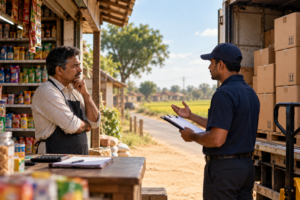
Ten-minute grocery delivery has moved remarkably quickly from novelty to habit in urban India. What began as an emergency purchase of milk, vegetables or a forgotten ingredient is steadily expanding into beauty products, electronics accessories, household goods and increasingly the wider retail basket.
The growth is real. So is the progress towards profitability. Blinkit reported adjusted EBITDA of ₹102 crore in the June 2026 quarter, with its adjusted EBITDA margin reaching 0.6% of Net Order Value. Swiggy’s Instamart, while not yet EBITDA-positive, reported a contribution margin of just -0.2% of Gross Order Value in the same quarter, a substantial improvement from a year earlier. [1][2]
That makes the interesting question no longer whether quick commerce can ever make money.
The more difficult question is whether the economics remain attractive when the industry matures.
India has demonstrated that consumers like instant convenience. What has not yet been fully demonstrated is whether the consumer price, rider income, supplier margin, platform return and capital required to provide that convenience can all reach a sustainable equilibrium at the same time.
Convenience Has a Cost — Even When the Consumer Does Not See It
Traditional grocery shopping makes the consumer perform a surprisingly important part of the logistics chain.
The consumer walks or drives to the shop, selects the goods, consolidates purchases and transports them home. The neighbourhood kirana effectively brings inventory close to the consumer, but the final few hundred metres are normally completed by the customer.
Quick commerce reverses this arrangement.
Inventory has to be positioned within a small radius of the consumer. A dark store has to be operated. Someone picks and packs the order. A rider is dispatched. A vehicle travels to the customer’s location. Technology coordinates the entire transaction — often for a basket that may contain only a handful of products.
That is objectively a premium service.
Yet consumers were introduced to much of quick commerce through discounted products, coupons, low or waived delivery charges and intense competition between platforms.
The danger is that an industry may be conditioning consumers to expect premium convenience at commodity prices.
India’s price sensitivity makes this particularly important. The issue is not that Indian consumers are unwilling to spend. They regularly pay substantial premiums for products and experiences they value. The more relevant characteristic is a strong tendency to compare value and resist paying materially more when a close substitute is available elsewhere.
An emergency medicine, forgotten ingredient or late-night requirement may justify a convenience premium. Paying an additional amount every time a household purchases atta, milk, oil or detergent may be a different proposition.
This creates the first long-term question:
When discounts moderate and profitability becomes the priority, how much of today’s order frequency survives if consumers are required to pay more of the actual convenience cost?
Improving Basket Size May Not Tell the Whole Story
Platforms understandably focus on Average Order Value and order frequency when explaining improving unit economics.
But nominal basket growth needs to be interpreted carefully.
A ₹600 basket becoming ₹660 is not necessarily evidence that the consumer has meaningfully expanded consumption. Some increase may simply reflect inflation or changes in product mix.
The more useful measures would be:
real basket growth after inflation,
units purchased per order,
contribution generated per order, and
frequency growth without incremental subsidy.
Blinkit’s recent performance illustrates why the distinction matters. Its June 2026 quarter produced an 86% year-on-year increase in Net Order Value, but Reuters reported that growth was driven more by increased order frequency than by consumers spending more per order. [1]
That is not inherently negative — frequent purchasing can create powerful economics — but it raises another question.
There may be a natural ceiling to how large the routine grocery basket of an average Indian household can become. Unlike software or digital advertising, purchasing power cannot scale infinitely with platform penetration.
The Rider Is More Than a Variable Cost
The second structural constraint sits on two wheels.
Delivery riders are often treated economically as a variable cost that should become progressively more efficient as order density increases. Density certainly helps. Better routing, shorter distances and more orders per hour can improve productivity.
But there is also a physical ceiling.
A rider still encounters traffic, lifts, security gates, parking, weather, waiting time and the unavoidable minutes involved in physically transporting goods from one location to another.
At the same time, India’s gig economy is maturing.
Riders bear costs including fuel or charging, vehicle maintenance, depreciation and time between orders. Fairwork India’s assessment of major platforms found that only a small minority could demonstrate that workers were guaranteed at least the applicable minimum wage after work-related costs, and none demonstrated a guarantee of a local living wage after such costs. [3]
Regulation is also moving towards greater formalisation. Under India’s Social Security Code framework, aggregators are required to contribute 1–2% of annual turnover, subject to a ceiling of 5% of payments made or payable to gig and platform workers, towards social-security arrangements. The framework contemplates benefits including life and disability cover, health, maternity, accident and old-age protection. [4]
This is a socially understandable evolution. But economically it means that costs historically borne partly by workers may increasingly become visible within the platform economy.
Add fuel, vehicle maintenance, insurance and general wage inflation, and an assumption that delivery cost per order will keep declining indefinitely deserves scrutiny.
Technology can improve productivity.
It cannot repeal geography.
The Dark Store Has Its Own Contradiction
The consumer wants more choice.
The platform wants more frequent purchases.
Both encourage quick-commerce companies to expand their assortment far beyond basic grocery.
But inventory economics pushes in the opposite direction.
More SKUs mean more inventory positions, more working capital and more slow-moving products. Grocery adds perishability: fruit, vegetables, dairy, bakery and other short-life goods create forecasting, expiry, markdown and disposal risks.
The operating tension is straightforward:
Consumers want the dark store to stock almost everything. Efficient inventory wants the dark store to stock only what moves quickly.
Expansion into higher-margin discretionary categories may help resolve part of this problem. Beauty, personal care, speciality food and electronics accessories can provide economics that ordinary staples may not.
That suggests quick commerce’s future may ultimately depend less on whether it can deliver groceries profitably and more on whether high-frequency grocery orders can create the traffic through which higher-margin products, advertising and services are monetised.
India Is Not One Retail Market
Perhaps the biggest danger in assessing quick commerce is extrapolating metropolitan behaviour across India.
Government data describes India’s general-trade ecosystem as comprising more than 1.4 crore kirana stores and accounting for approximately 75–80% of FMCG sales. [5]
Meanwhile, NielsenIQ reported that e-commerce represented around 6% of urban FMCG sales, rising to 14% across metros and 18% across the top eight metros by late 2025. Quick commerce represented more than three-fourths of that e-commerce FMCG business. [6]
Both observations can simultaneously be true.
Quick commerce can be transformative in metropolitan India and still represent only one part of the national retail architecture.
The economics that work in a dense, affluent neighbourhood are fundamentally different from those in a small town or semi-rural market.
As platforms travel outward, several things can change simultaneously:
- order density can fall;
- delivery distance can increase;
- rider utilisation can decline;
- basket sizes can become more constrained;
- consumer price sensitivity can rise.
There may therefore be a geographic profitability frontier beyond which instant delivery becomes increasingly difficult to justify economically.
Interestingly, incumbents are already testing that boundary. Flipkart and Amazon have been rapidly expanding their quick-commerce offerings, including into smaller cities, while Reliance says JioMart’s quick-commerce network is leveraging more than 3,100 existing stores across over 1,200 cities and 5,100 PIN codes. [7][8]
This may ultimately prove that quick commerce can travel well beyond metros.
Or it may demonstrate that the economics work best when quick commerce can be layered onto infrastructure that already exists.
That distinction matters enormously.
India Already Has an Extraordinary Last-Mile Network
India did not enter quick commerce with an empty retail landscape.
It already had millions of privately financed neighbourhood fulfilment points: the kiranas.
The shopkeeper typically bears the cost of the premises, inventory, electricity, labour, working capital and entrepreneurial risk. Many know local demand intimately, accept relatively modest absolute returns and sometimes provide informal credit or local delivery.
The consumer frequently lives within walking distance.
Quick commerce offers substantially greater convenience, but it also replaces part of this remarkably low-cost arrangement with:
dark store + inventory + technology + picker + rider + vehicle + delivery.
This does not make quick commerce inferior.
It simply means it has to create sufficient additional value to pay for the additional infrastructure.
The long-term outcome may therefore be coexistence rather than replacement.
The Manufacturer May Face the Most Complicated Equation
For an FMCG manufacturer, quick commerce initially looks extremely attractive.
It provides fast access to consumers, product discovery, promotional opportunities and increasingly significant sales volumes. According to industry data reported in May 2026, quick commerce already accounted for roughly 60–75% of online sales for several major FMCG companies, although its share of their total offline-plus-online business remains much smaller. Another estimate placed quick commerce at around 6% of FMCG companies’ overall sales, with considerably higher exposure for certain companies and categories. [9][10]
But manufacturers cannot simply dismantle their existing distribution systems.
They still need distributors, kiranas, modern trade and other e-commerce platforms.
This means the transition does not necessarily replace an old cost structure with a new one.
For some period it can create:
old distribution infrastructure + new platform infrastructure.
And every channel wants economics.
The traditional distributor needs sufficient margin to cover logistics, warehousing, manpower, financing and compliance. In June 2026, the All India Consumer Products Distributors Federation, representing more than 4.5 lakh distributors servicing over 1.3 crore outlets, argued that prevailing distributor margins of around 3.5–5% were becoming difficult to sustain as operating costs increased. It warned of collective action unless manufacturers reviewed the economics. [11]
Modern trade seeks its own commercial arrangements.
Quick-commerce platforms increasingly seek margins, promotions and marketing expenditure.
All while the consumer can see the same MRP printed on the packet.
The result is unavoidable channel friction.
Indeed, the distributors’ federation has previously approached the Competition Commission of India alleging deep discounting and predatory pricing by major quick-commerce platforms. Those remain allegations rather than established findings, but they demonstrate the level of tension developing between distribution channels. [12]
The Digital Shelf Is Becoming Expensive
There is another cost that is easy to underestimate.
A manufacturer may save some physical distribution expense through digital channels, but that saving does not automatically become additional profit.
On a quick-commerce platform, being available is not the same as being visible.
Brands compete for search placement, sponsored listings, category visibility, promotional slots and digital campaigns.
Advertising is consequently becoming a significant profit engine for the platforms. Industry estimates reported in April 2026 projected quick-commerce advertising revenue of roughly ₹4,900 crore in 2026, up from around ₹3,000 crore in the previous year. [13]
More recently, executives at consumer-goods companies have reported platforms seeking higher margins, larger marketing budgets and even auction-style bidding around search keywords and product placement. [14]
This leads to a useful way of thinking about the shift:
Quick commerce may reduce the cost of reaching the shelf while increasing the cost of being seen on the shelf.
The platform also possesses increasingly valuable consumer intelligence — searches, conversions, substitutions, purchasing frequency, promotion response and hyperlocal demand patterns.
Traditionally, manufacturers built substantial market intelligence through their own distributor and sales networks. In the platform model, some of the richest behavioural information sits with the intermediary controlling the transaction.
The issue is therefore not merely distribution cost.
It is also who owns the customer relationship and who owns the information generated by it.
Growth Can Gradually Become Dependence
At first, manufacturers can rationally accept relatively expensive platform economics because the sales are incremental.
But once a meaningful share of urban growth flows through those platforms, negotiating power can change.
What began as:
“This is an additional channel.”
can slowly become:
“We cannot afford to lose visibility on this channel.”
At that point, advertising expenditure, promotional funding or platform margins become harder to resist.
Manufacturers may therefore gain reach while gradually surrendering some distribution independence.
But the dependence can also run the other way.
Quick commerce provides an exceptionally efficient way for a new consumer brand to establish itself. An unknown supplier can obtain urban visibility and rapidly demonstrate demand without first constructing a national physical distribution network.
Initially, accepting weak margins may make sense because the platform provides something more valuable: market entry and credibility.
Once that brand becomes established, however, traditional distributors and retailers may become far more willing to stock it.
The brand can then expand into general trade, modern trade, D2C and other channels — and begin questioning whether permanently paying high digital-platform economics still makes sense.
This creates what might be called the platform-graduation risk.
At entry, the brand may need the platform. At maturity, the platform may increasingly need the brand.
Whether this becomes significant remains to be seen, but it limits the assumption that platform bargaining power can increase indefinitely.
Then Come the Incumbents
There is one final strategic complication.
New-age companies have spent enormous sums developing consumer behaviour, dark-store operating models, delivery systems and category knowledge.
But some of India’s largest companies have not needed to undertake the same learning journey from scratch.
Amazon and Walmart-owned Flipkart are now accelerating quick commerce. Reuters reported in June 2026 that Flipkart had reached about 1,000 fulfilment centres and planned further expansion, while Amazon was substantially expanding its Now service. [7]
Reliance enters from yet another position because it already possesses a vast retail and supply-chain network. [8]
This raises a strategic risk familiar from other disrupted markets:
First movers may bear much of the cost of creating the market, while later entrants arrive with existing infrastructure, stronger balance sheets and the benefit of observing what worked.
It would be premature to describe this as a deliberate “Jio strategy” in quick commerce.
But it is certainly a competitive scenario worth watching.
Perhaps the Market Does Not Need One Winner
Much of the discussion around quick commerce assumes that Indian retail is moving from one model to another.
The eventual outcome may be more nuanced.
Routine staples, highly price-sensitive purchases and much of semi-urban and rural consumption may continue to favour traditional distribution.
Urgent purchases can favour quick commerce because the occasion itself makes convenience valuable, even when the product is ordinary.
Premium, discretionary and impulse categories may be particularly well suited to quick commerce because higher margins and product discovery can better absorb delivery economics. Industry analysis already shows greater quick-commerce penetration among several premium and impulse-oriented FMCG categories, although daily essentials are also gaining traction. [10]
Modern retail may retain its advantage for planned larger baskets.
Traditional e-commerce can remain strong where assortment matters more than immediate delivery.
Instead of one model replacing another, India may develop a layered retail architecture:
kirana for proximity and value;
modern trade for planned baskets;
e-commerce for assortment;
quick commerce for urgency, discovery and premium convenience.
And the same consumer may use all four.
What Should We Watch From Here?
This inquiry does not require a verdict today.
The more useful approach may be to watch a few indicators over the next several years.
Does average order value grow meaningfully after inflation, or merely in nominal terms?
Can platforms continue reducing delivery cost while rider real incomes and social protections improve?
Do consumers eventually accept meaningful delivery or convenience charges?
Can dark stores expand assortment without materially increasing inventory waste and working-capital requirements?
Does quick commerce successfully move beyond affluent urban clusters?
Do manufacturers’ total channel costs decline, or are traditional distribution expenses simply supplemented by platform margins and advertising?
Does platform advertising remain genuinely incremental marketing, or evolve into an unavoidable cost of digital distribution?
Do successful new brands remain dependent on quick commerce, or use it as a launchpad into cheaper traditional channels?
And perhaps most importantly, once growth normalises, what return on capital does a mature quick-commerce network actually generate?
Blinkit’s emerging profitability and Instamart’s improving unit economics are important evidence that the model should not be dismissed. [1][2]
But equally, India’s existing retail structure, income distribution, gig-worker economics and manufacturer-channel relationships suggest that extrapolating today’s metropolitan growth indefinitely would be equally premature.
India has unquestionably proved that consumers value instant convenience.
What remains unresolved is how much consumers will ultimately pay for it, how much suppliers will surrender for access to it, how much riders must earn to provide it, and what return investors will eventually require from the capital supporting it.
The future of Indian retail may therefore not be a contest in which quick commerce destroys the kirana.
It may instead become a negotiation over where convenience genuinely creates enough economic value to justify its cost.
And that boundary — across products, income groups and geography — may ultimately determine the true size of India’s ten-minute economy.
Sources
[1] Reuters, 22 July 2026 — India’s Eternal sees Blinkit profitability at high end of outlook as efficiency improves. Blinkit reported ₹102 crore adjusted EBITDA and a 0.6% adjusted EBITDA margin on NOV for the June quarter; Reuters also noted that NOV growth was being driven more by order frequency than higher per-order spend.
[2] Swiggy, August 2026 — FY31 strategy update and Q1 FY27 operating data. Instamart reported ₹7,907 crore GOV, 40% YoY growth and contribution margin of -0.2%; Swiggy reported more than 14 million monthly transacting users and 1,200+ dark stores.
[3] Fairwork India — latest assessment of platform labour standards. Fairwork found only bigbasket and Urban Company provided sufficient evidence of an after-cost minimum-wage guarantee, while none demonstrated an after-cost local living-wage guarantee for all workers.
[4] Press Information Bureau, Government of India, 2025 — Labour Reforms: Formalising and Safeguarding India’s Gig & Platform Workforce. Social Security Code provisions include aggregator contributions of 1–2% of turnover, capped at 5% of payments to gig/platform workers.
[5] DPIIT / Press Information Bureau, 12 June 2026 — India’s general-trade ecosystem includes more than 1.4 crore kiranas and accounts for around 75–80% of FMCG sales.
[6] NielsenIQ, 2026 — GST 2.0 Transition Reshapes India’s FMCG Growth Landscape. E-commerce represented approximately 6% of urban FMCG sales, 14% across metros and 18% in the top eight metros; quick commerce contributed more than three-fourths of e-commerce FMCG sales.
[7] Economic Times, 24 June 2026 — Walmart’s Flipkart, Amazon step up India ‘quick commerce’ bet as competition heats up. Covers Flipkart Minutes and Amazon Now expansion and intensifying competition.
[8] Reliance Industries, Chairman’s Statement, 2026 — JioMart reported a quick-commerce network using 3,100+ stores, serving 1,200+ cities and more than 5,100 PIN codes.
[9] The Economic Times, 27 May 2026 — Quick commerce becomes FMCG’s biggest online sales channel in India. Reported quick commerce representing approximately 60–75% of online sales for several major FMCG companies.
[10] The Economic Times, 21 May 2026 — Q-comm sales for FMCG giants double this year. Citing Kotak Investment Banking estimates, quick commerce represented around 6% of FMCG companies’ total sales, with higher penetration for particular companies and stronger traction among premium and impulse categories.
[11] Brand Equity – Economic times / AICPDF, June 2026 — AICPDF, representing over 4.5 lakh distributors servicing more than 1.3 crore outlets, sought revisions to distributor margins of roughly 3.5–5%, citing higher fuel, logistics, warehousing, manpower and other costs.
[12] The Economic Times, 6 March 2025 — AICPDF complaint to the Competition Commission of India alleging deep discounting and predatory pricing by Blinkit, Zepto and Swiggy Instamart. The allegations are cited as evidence of channel friction, not as established findings.
[13] The Economic Times / Deloitte and Datum Intelligence estimates, 2 April 2026 — quick-commerce platforms were projected to generate approximately ₹4,900 crore in advertising revenue in 2026, compared with roughly ₹3,000 crore in the prior year.
[14] The Economic Times, 21 July 2026 — Quick commerce leverages cart clout to draw higher margins from companies. Consumer-goods executives reported rising platform demands for margins, marketing funding and auction-style bidding for listings and keywords.
Related reading: Zepto IPO review · When ₹552 became a governance lesson
Disclaimer
The core concepts, intellectual frameworks, and primary conclusions presented in this post—whether exploring macroeconomics, technology, governance, or philosophical inquiry—are the result of extensive synthesis, wide-ranging study, and the author’s personal observations of global developments and literature. In alignment with modern digital workflows, advanced generative AI were utilized as a collaborative tool to assist in refining prose, structuring editorial layouts, and drafting supporting conceptual imagery. All final content is personally curated, reviewed, and approved by the author.