The Anatomy of Cognitive Blindspots
This article explores the psychological, neurological, and behavioral mechanisms that contribute to cognitive blindspots and self-justification. Drawing from cognitive dissonance theory, confirmation bias, escalation of commitment, and contemporary neuroscience, it examines why individuals frequently resist updating beliefs when confronted with contradictory evidence. Particular emphasis is placed on financial markets, where these tendencies become highly visible through trading behavior and risk management failures. The article argues that the central challenge is not a lack of intelligence but an attachment to existing narratives and identities. To mitigate these effects, it proposes practical frameworks including probabilistic thinking, adversarial analysis, identity separation, predefined invalidation criteria, and systematic decision documentation. Ultimately, the article presents cognitive adaptability—not certainty—as the cornerstone of effective decision-making in both markets and life.
Executive Summary
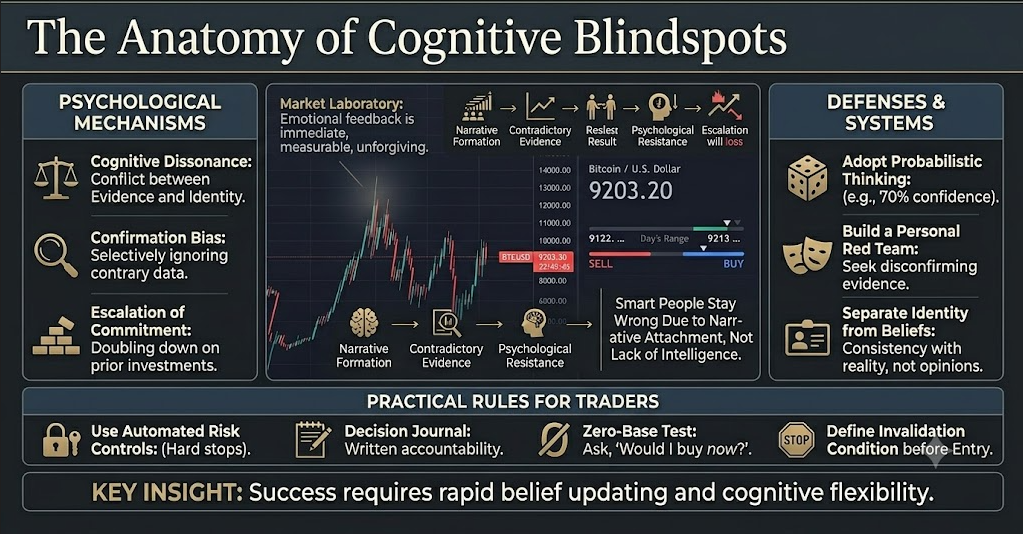
Human beings naturally construct narratives to interpret complex environments. While these narratives facilitate decision-making, they can also create cognitive blindspots when new evidence challenges established beliefs. Psychological mechanisms such as cognitive dissonance, confirmation bias, and escalation of commitment often motivate individuals to defend existing perspectives rather than revise them.
Financial markets provide a particularly revealing environment for observing these tendencies because feedback is immediate, measurable, and unforgiving. Traders frequently progress from conviction to rationalization, selectively interpreting information and increasing risk exposure in an effort to validate prior decisions.
Neuroscience suggests that stress and perceived threats to identity can impair higher-order reasoning, making objective reassessment more difficult precisely when it is most needed. Additionally, the brain’s preference for cognitive efficiency encourages preservation of existing mental models rather than costly reconstruction.
The article proposes that effective decision-making requires external systems rather than reliance on willpower alone. Practical solutions include adopting probabilistic thinking, actively seeking opposing viewpoints, separating identity from beliefs, defining invalidation criteria before committing to decisions, and maintaining objective records of decision processes.
The core conclusion is that success depends less on being consistently right and more on the ability to rapidly update beliefs when reality changes. Cognitive flexibility, rather than conviction, is the defining characteristic of resilient decision-makers.
Psychology, Neuroscience, and the Hidden Architecture of Self-Justification
Introduction: Why Smart People Stay Wrong
Human beings like to imagine themselves as objective decision-makers. In reality, our minds are optimized less for perfect accuracy and more for building coherent interpretations of the world.
We continuously construct narratives from incomplete information. These narratives help us navigate complexity, make decisions, and maintain a stable sense of identity. Most of the time, this process works remarkably well. The problem arises when reality changes and begins to contradict a narrative we have already committed to.
At that moment, the challenge is no longer analytical—it becomes psychological.
Instead of updating our beliefs to incorporate new evidence, we often defend the original position. We reinterpret conflicting information, search for confirming evidence, and construct increasingly sophisticated justifications for decisions that may no longer be valid.
This pattern appears in business, politics, relationships, and everyday life. Nowhere, however, is it more visible—or more expensive—than in financial markets.
This article examines the psychological, neurological, and behavioral mechanisms that create cognitive blindspots and explores practical methods for overcoming them.
The Psychology of Self-Justification
Several well-established psychological mechanisms help explain why individuals struggle to abandon flawed ideas.
Cognitive Dissonance
Psychologist Leon Festinger introduced the concept of cognitive dissonance in 1957. The theory describes the discomfort that arises when a person simultaneously holds conflicting beliefs or when new evidence contradicts an important prior decision.
A trader who believes they have identified a high-probability opportunity experiences psychological tension when the market moves decisively against that position.
The conflict is not merely between belief and evidence.
It often becomes a conflict between evidence and identity.
If the original decision was tied to intelligence, expertise, or self-worth, admitting error can feel like a threat to one’s competence rather than a routine reassessment of information.
Confirmation Bias
Once a position has been adopted, confirmation bias begins shaping how information is processed.
People naturally pay greater attention to evidence supporting their existing beliefs and give less weight to information that challenges them.
This process is rarely deliberate. More often, it operates beneath conscious awareness.
The result is a distorted information environment where supporting evidence feels abundant while contradictory evidence appears weak, unreliable, or irrelevant.
Escalation of Commitment
As more resources become invested in a decision—whether time, money, reputation, or emotional energy—the cost of changing course increases.
Researchers refer to this phenomenon as escalation of commitment.
Rather than abandoning an increasingly questionable path, individuals often commit additional resources in an attempt to justify previous investments.
The original goal shifts from achieving the best outcome to proving that the original decision was correct.
The Financial Markets as a Laboratory of Human Psychology
Financial markets provide a uniquely unforgiving environment for cognitive blindspots.
Unlike many areas of life, markets generate immediate and measurable feedback. Every decision eventually encounters objective price action.
A common progression unfolds as follows:
Phase 1: Narrative Formation
A trader develops a directional thesis based on available information and enters a position with confidence.
Phase 2: Contradictory Evidence Emerges
Price action begins moving against the trade. Key assumptions are challenged. New information weakens the original thesis.
Phase 3: Psychological Resistance
Rather than reassessing the position, the trader experiences cognitive dissonance.
The loss is no longer merely financial—it becomes personal.
Phase 4: Selective Information Gathering
The trader searches for analysts, indicators, news sources, or online communities that reinforce the original position while dismissing contrary evidence.
Phase 5: Escalation
The trader increases exposure, widens stop-loss levels, or abandons predefined risk parameters.
At this stage, the position often ceases to be a structured trade and becomes an attempt to defend a prior belief.
Importantly, not all averaging down or persistence is irrational. Long-term investors and systematic traders may add to positions according to predefined rules.
The distinction is simple:
Disciplined scaling follows a plan. Emotional averaging follows a hope.
The Neurobiology of Being Wrong
The difficulty of changing one’s mind is not solely psychological.
It is also influenced by how the brain responds to perceived threats and uncertainty.
Emotional Threat and Executive Function
When individuals encounter information suggesting a significant mistake, emotional processing networks become more active.
Research suggests that stress and perceived threats can impair functions associated with the prefrontal cortex—the region involved in planning, reasoning, impulse control, and risk evaluation.
Under conditions of uncertainty and loss, people often become less analytical precisely when analytical thinking is needed most.
This helps explain why otherwise intelligent individuals can make surprisingly irrational decisions during emotionally charged situations.
The Efficiency Bias of the Brain
The brain is an energy-efficient system.
Existing mental models are cognitively inexpensive to maintain. Revising those models requires effort, attention, and cognitive flexibility.
As a result, defending an existing belief can feel easier than reconstructing it from the ground up.
The challenge is not merely accepting new information.
It is replacing an established mental framework with a new one.
Building Defenses Against Cognitive Blindspots
Overcoming cognitive blindspots is rarely a matter of willpower.
More often, it requires systems that reduce the influence of emotional decision-making.
Adopt Probabilistic Thinking
Treat beliefs as probabilities rather than certainties.
A thesis held with 70% confidence automatically contains a 30% chance of being wrong.
When viewed through a probabilistic lens, updating a belief becomes a rational adjustment rather than an identity crisis.
Build a Personal Red Team
Before committing to a major decision, actively construct the strongest possible argument against your position.
Seek disconfirming evidence.
Ask:
“What would convince me that I am wrong?”
If no answer exists, the problem is likely psychological rather than analytical.
Separate Identity from Ideas
Strong thinkers are not defined by never being wrong.
They are defined by their ability to recognize error and adapt quickly.
The objective is not consistency of opinion.
The objective is consistency with reality.
Practical Rules for Traders
Because markets provide continuous feedback, traders benefit from especially rigid safeguards.
Define Invalidation Before Entry
Every trade should include a predefined condition that invalidates the thesis.
This condition must be determined before capital is committed.
Once emotions become involved, objectivity becomes more difficult.
Use Automated Risk Controls
Hard stop-loss orders, position limits, and predetermined exposure caps help protect against emotionally driven decision-making.
Systems are often more reliable than willpower.
Apply the Zero-Base Test
Periodically ask:
- If I held no position in this asset today, would I initiate this trade at the current price?
If the answer is no, continuing to hold the position may simply be a manifestation of commitment to the past.
Maintain a Decision Journal
Document both the reasons for entering a trade and the conditions that would invalidate it.
A written record creates accountability and makes post-hoc rationalizations easier to detect.
Conclusion
The greatest threat to sound decision-making is often not ignorance but attachment.
Human beings are remarkably capable of defending beliefs long after evidence has shifted against them. Cognitive dissonance, confirmation bias, and escalation of commitment are not signs of weakness; they are common features of human cognition.
The goal is not to eliminate these tendencies entirely.
The goal is to recognize them early and build systems that reduce their influence.
In markets—and in life—the individuals who adapt fastest are rarely those who are right most often.
They are the ones who can abandon a flawed thesis before it becomes part of their identity.
Disclaimer
The core concepts, intellectual frameworks, and primary conclusions presented in this post—whether exploring macroeconomics, technology, governance, or philosophical inquiry—are the result of extensive synthesis, wide-ranging study, and the author’s personal observations of global developments and literature. In alignment with modern digital workflows, advanced generative AI were utilized as a collaborative tool to assist in refining prose, structuring editorial layouts, and drafting supporting conceptual imagery. All final content is personally curated, reviewed, and approved by the author.