Sanatan Dharma: A Philosophical Reflection on Dharma, Karma, Natural Order, and Harmonious Living
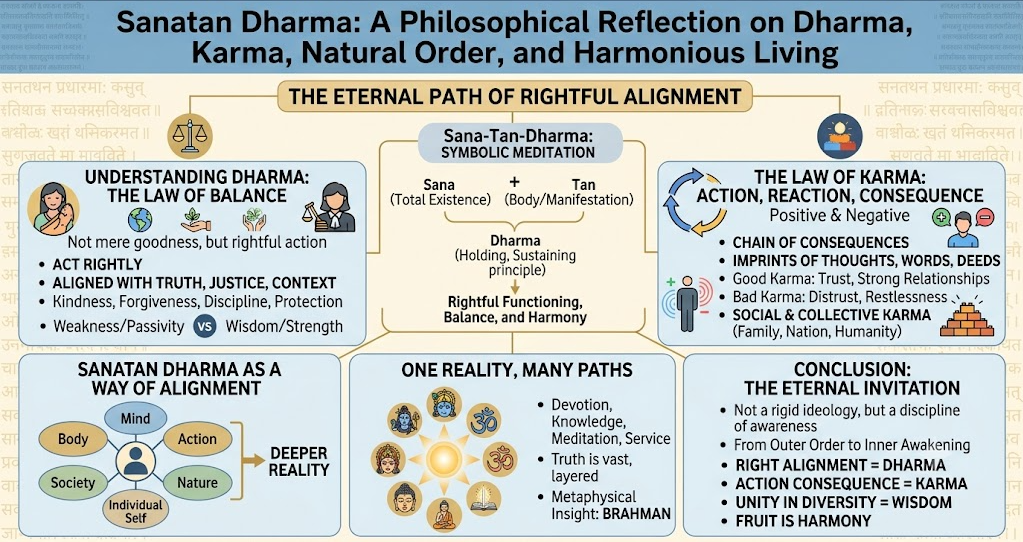
This article presents Sanatan Dharma as an eternal philosophy of rightful alignment, where Dharma is not merely goodness but the sustaining law of balance, justice, responsibility, and consequence. Through the symbolic lens of Sana–Tan–Dharma, it reflects on the Dharma of matter, nature, human action, society, and consciousness, while linking Dharma with Karma as the law of action and response. It emphasizes that Sanatan Dharma is a living framework of wisdom, capable of holding peace and power, compassion and correction, unity and diversity, without reducing itself to ritual, dogma, or forced scientific claims. Ultimately, it portrays Sanatan Dharma as a path for cultivating awareness, disciplined action, inner awakening, social harmony, and reverence for the interconnected order of existence.
Introduction: Understanding Sanatan Dharma Beyond a Narrow Definition
Sanatan Dharma is often translated in modern language as “Hindu religion.” While this translation is convenient, it is incomplete. Sanatan Dharma certainly includes what is commonly understood as religion: worship, devotion, temples, rituals, scriptures, festivals, sacred stories, philosophy, and spiritual practices. Yet it also extends beyond religion in the narrow sense. It is a civilizational, philosophical, ethical, and spiritual framework that reflects on the nature of existence, the purpose of life, the responsibility of human action, and the search for harmony.
The word Sanatan is traditionally understood in Sanskrit as eternal, ancient, everlasting, or perennial. This established meaning must be respected. Sanatan Dharma, in that sense, means the eternal Dharma: the timeless principle that sustains life, order, truth, and spiritual movement.
At the same time, for personal contemplation, one may also reflect on the sound and structure of the expression Sana–Tan–Dharma in a symbolic way. This interpretation is not presented as a strict academic or linguistic etymology. Rather, it is a philosophical meditation.
In this reflective interpretation:
Sana may be understood as the totality — all existence, all beings, all forms, all that is contained within the universe.
Tan may be understood as body, form, embodiment, or physical manifestation — the visible and experiential expression of existence.
Dharma comes from the Sanskrit root dhṛ, meaning to hold, sustain, support, or maintain. In its deeper sense, Dharma is the principle that sustains balance, order, truth, responsibility, and rightful functioning.
Thus, in this contemplative reading, Sanatan Dharma may be understood as the eternal principle that guides all forms of existence toward rightful functioning, balance, consequence, and harmony.
This is not merely a doctrine of belief. It is a way of seeing. It asks: What sustains life? What disturbs life? What is right action? What is the consequence of action? How should a human being live with the body, mind, society, nature, and the deeper reality of existence?
Sanatan Dharma is therefore not only about worship. It is about living with awareness.
I. Dharma: Not Mere Goodness, but the Law That Sustains Balance
The word Dharma is often simplified as duty, morality, righteousness, goodness, or religion. While all these meanings are related, none of them alone captures its full depth. Dharma is not merely a command to be gentle, soft, peaceful, agreeable, or passive. Dharma is the sustaining principle of existence. It is that which holds life, society, nature, and consciousness in balance.
Dharma is therefore broader than moral sweetness. It is not simply “be good.” It is “act rightly.”
And right action depends on truth, context, responsibility, proportion, and consequence.
When kindness sustains balance, kindness is Dharma.
When forgiveness heals, forgiveness is Dharma.
When discipline is required, discipline is Dharma.
When law must be enforced, enforcement is Dharma.
When punishment prevents greater harm, punishment may also become Dharma.
When destructive forces threaten the innocent, rightful resistance may become Dharma.
Therefore, Dharma is not weakness. It is not sentimental goodness. It is not the avoidance of conflict at all costs. Dharma is the action required by the truth of the situation.
A mother feeding her child is acting according to Dharma. A teacher correcting a student may be acting according to Dharma. A judge punishing a criminal may be acting according to Dharma. A ruler protecting citizens from aggression may be acting according to Dharma. A person defending the weak from exploitation may be acting according to Dharma.
The same principle can appear gentle in one moment and forceful in another. What matters is not whether the action looks soft or hard from outside. What matters is whether it is aligned with truth, justice, responsibility, proportion, and the welfare of the whole.
This is why Sanatan Dharma does not teach blind passivity. Ahimsa, or non-injury, is a supreme value, but it does not mean allowing injustice to destroy the innocent. If violence is driven by ego, hatred, greed, revenge, domination, or cruelty, it is Adharma. But if force is used as a last resort, with discipline, proportion, and the intention to protect Dharma itself, then such action may become rightful.
This is the subtle balance of Dharma: it does not glorify violence, but neither does it glorify helplessness. It asks the human being to act with wisdom.
Softness without strength may become weakness.
Strength without wisdom may become violence.
Dharma is the balance between the two.
II. Dharma in Nature: Calm, Violent, Creative, and Destructive
Nature itself teaches that balance is not always gentle. Nature is calm, but nature can also be violent. Nature nourishes, but nature also destroys. Nature creates, preserves, transforms, and dissolves.
The same ocean that supports life can become a storm. The same fire that cooks food can burn a forest. The same rain that nourishes crops can become a flood. The same earth that supports our bodies can shake as an earthquake. The same wind that cools the skin can become a cyclone.
This does not make nature evil. It shows that nature is not governed by human sentiment. Nature is governed by law, balance, pressure, reaction, transformation, and consequence.
In the physical world, all things operate within conditions and limits. A stone, a river, a flame, a tree, a cloud, and a human body all behave according to their nature. In traditional philosophical language, one may call this Vastu Dharma — the Dharma of objects, matter, or material forms. This does not mean that matter has moral intention in the human sense. Rather, it means that each object or element has an inherent nature, limitation, tendency, and condition of functioning.
A solid object responds to pressure according to its material nature. Water flows, freezes, evaporates, nourishes, and adapts. Fire transforms. Air moves. Earth supports. These are not moral actions, but they remind us that existence is not random. There is order, relationship, interdependence, and consequence.
In this sense, Dharma is not only about human ethics. It is a universal way of reflecting on rightful functioning. A seed has its Dharma when it grows into a tree under the right conditions. A river has its Dharma when it flows and nourishes life. A body has its Dharma when it is cared for through food, rest, movement, and moderation. A mind has its Dharma when it is guided by clarity, restraint, compassion, courage, and truth. A society has its Dharma when justice, responsibility, cooperation, and mutual respect are preserved.
Nature also reminds us that destruction is not always meaningless. Sometimes destruction clears the old for the new. Sometimes correction restores balance. Sometimes force prevents greater disorder. But when force is uncontrolled, excessive, selfish, or blind, it becomes destructive beyond Dharma.
Thus, the lesson of nature is not that everything must be soft. The lesson is that everything must remain aligned with balance.
III. The Human Being: Freedom, Responsibility, and Inner Conflict
Plants, animals, rivers, mountains, fire, and wind operate according to their nature. Human beings also belong to nature, but they carry a special responsibility because they possess reflective awareness. A human being can choose. A human being can cooperate or exploit. A human being can preserve or destroy. A human being can discipline desire or become enslaved by it.
Human nature is complex. A person can be calm, loving, generous, disciplined, and wise. The same person, under different conditions, can become angry, selfish, jealous, violent, or destructive. These possibilities exist within the human field of nature.
Sanatan Dharma does not deny this complexity. It recognizes it and tries to guide it.
The purpose of Dharma is not to pretend that anger, conflict, punishment, force, and destruction do not exist. The purpose of Dharma is to regulate them, purify them, and place them under the guidance of wisdom.
Anger under ego becomes destruction.
Anger under Dharma becomes courage against injustice.
Power under ego becomes oppression.
Power under Dharma becomes protection.
Punishment under ego becomes revenge.
Punishment under Dharma becomes correction and restoration of order.
Desire under ego becomes addiction.
Desire under Dharma becomes purposeful living.
Knowledge under ego becomes arrogance.
Knowledge under Dharma becomes wisdom.
This is why Dharma must always be connected with self-control. Without self-control, even a righteous cause can become polluted by ego. With self-control, even a difficult action can become an instrument of balance.
For the human being, Dharma includes right conduct, ethical responsibility, discipline, truthfulness, non-injury, courage, compassion, justice, and awareness of consequence. It includes the discipline to live in a way that does not damage the body, disturb the mind, exploit others, or violate nature.
Human Dharma is not automatic. It must be cultivated.
IV. Karma: The Law of Action, Reaction, and Consequence
The concept of Karma is central to understanding Sanatan Dharma. Karma does not merely mean fate. It means action, and more deeply, the chain of consequences created by action.
Every action leaves an imprint. Every thought, word, habit, decision, and behavior shapes the field around us. Some consequences are immediate. Others are delayed. Some are visible. Others are subtle. Some return through people. Others return through circumstances, society, nature, or the inner condition of the mind itself.
If a person repeatedly behaves with honesty, kindness, discipline, courage, and responsibility, he slowly creates trust around himself. People feel safe near him. His relationships become stronger. His mind becomes clearer. His environment becomes more supportive. Good Karma is not merely magic; it is also the natural flowering of repeated right action.
If a person repeatedly lies, exploits, insults, deceives, or harms others, the result may not appear immediately. He may even appear successful for some time. But slowly, distrust gathers around him. Relationships weaken. Fear increases. His own mind becomes restless. People withdraw, resist, or retaliate. The environment he created begins to return to him.
This is Karma.
Karma is not merely reward and punishment imposed from outside. It is the deep structure of consequence woven into existence.
A word spoken in anger creates one kind of atmosphere. A word spoken with compassion creates another. A selfish action creates one environment. A selfless action creates another. A society built on greed creates one future. A society built on justice creates another. A civilization that respects nature receives one result. A civilization that exploits nature receives another.
Thus, Karma applies not only to the individual but also to families, communities, nations, and humanity as a whole. It applies to our relationship with nature, with animals, with resources, with knowledge, with power, and with one another.
In this sense, Dharma and Karma are inseparable.
Dharma tells us what kind of action is aligned with balance.
Karma reminds us that every action bears consequence.
Dharma is the wisdom of right action.
Karma is the law by which action returns its result.
Together, they form the moral and cosmic architecture of Sanatan thought.
V. Sanatan Dharma as a Way of Alignment, Not Mere Belief
Sanatan Dharma is not limited to belief in a particular form of God, although devotion to God is central for many. It is also not limited to ritual, although ritual has an important place. It is not limited to philosophy, although philosophical inquiry is deeply respected. It is not limited to meditation, although meditation is a powerful path.
Sanatan Dharma is a way of alignment.
It aligns the body with discipline.
It aligns the mind with clarity.
It aligns action with responsibility.
It aligns society with justice.
It aligns nature with reverence.
It aligns the individual self with the deeper reality.
In this framework, human life is not divided into separate compartments of religious and non-religious. Food, speech, sleep, family, work, money, knowledge, sexuality, power, governance, ecology, ritual, devotion, and meditation all become part of life’s moral and spiritual architecture.
The question is not simply, “What do I believe?”
The deeper question is, “How do I live?”
Do my actions sustain or disturb?
Do my words heal or wound?
Does my knowledge humble me or inflate me?
Does my wealth serve only me or also support others?
Does my strength protect or dominate?
Does my worship make me compassionate or proud?
Does my freedom create responsibility or indulgence?
This is the practical heart of Sanatan Dharma.
VI. The One Reality and the Many Paths
One of the most profound features of Sanatan thought is its ability to hold unity and diversity together. It recognizes that human beings approach truth through different names, forms, temperaments, practices, and levels of understanding.
One may worship the Divine as Krishna, Shiva, Devi, Rama, Vishnu, Ganesha, Surya, or countless other forms. One may approach the Absolute as personal God, impersonal Brahman, inner Self, cosmic consciousness, sacred nature, or the silent truth beyond all names. One may walk through devotion, knowledge, meditation, service, ritual, discipline, philosophical inquiry, or surrender.
This openness comes from a deep metaphysical insight: the One Reality can be approached through many expressions.
The Upanishadic vision points toward the profound idea that Brahman is the underlying reality of existence. Brahman is not merely one object among many. Brahman is the essence from which all arises, in which all exists, and into which all returns. In the deepest philosophical understanding, all beings exist within Brahman, and Brahman is the essence of all beings.
This does not mean that all paths are identical in practice, language, theology, or discipline. Different traditions may have different doctrines, rituals, and understandings of the sacred. But Sanatan Dharma has the capacity to recognize that truth is vast, reality is layered, and the Divine cannot be imprisoned in one exclusive formulation.
This openness does not mean that everything is automatically Dharma. Sanatan Dharma does not say every action is right. It does not say every desire is sacred. It does not say every belief leads to liberation. It does not erase the distinction between Dharma and Adharma.
Rather, it says that the Divine may be approached in many ways, but the life of the seeker must still be tested by truth, compassion, self-discipline, humility, justice, and the consequences of action.
The recognition of many paths is not moral laziness. It is spiritual vastness.
VII. The Four Vedas: Sacred Foundations and Philosophical Directions
The Vedas hold a central place in Sanatan tradition. They are regarded as Shruti, “that which is heard,” meaning sacred revelation received by the ancient seers. The Vedas are not simple books in the modern sense. They are vast collections of hymns, chants, ritual formulas, prayers, invocations, cosmological reflections, and spiritual insights.
The phrase “that which is heard” is especially significant because the Vedas were preserved through a highly disciplined oral tradition long before they were widely written down. The chanting patterns, recitation methods, tonal precision, and cross-checking structures acted almost like an ancient “audio checksum” system. They helped preserve sound, sequence, accent, and wording with extraordinary care across generations. In this sense, the oral tradition itself became a living archive — not merely memory, but a disciplined method of transmission.
It is helpful to understand the four Vedas through their broad orientation, while remembering that no single description can fully capture their complexity.
The Rigveda is the oldest and most hymn-oriented. It contains praises to divine powers, reflections on cosmic order, invocations to natural forces, and early contemplations on existence. Its spirit reminds us to approach the universe with wonder, gratitude, humility, and reverence.
The Yajurveda is closely associated with ritual action. It gives formulas and procedures connected with sacrifice and sacred performance. Philosophically, it teaches that action matters. Every action has consequence. When action is performed with discipline, offering, and responsibility, it becomes Yajna — a contribution to a larger order.
The Samaveda is associated with melody, chant, and liturgical singing. It points to the power of sound, rhythm, devotion, and inner refinement. Its deeper message is that human consciousness can be elevated through harmony — not only musical harmony, but emotional and spiritual harmony.
The Atharvaveda contains material related to healing, domestic life, protection, social welfare, royal concerns, and practical human anxieties. It reminds us that spirituality is not separate from daily life. Health, family, society, environment, and mental peace are also part of the sacred journey.
These Vedas should not be treated as modern scientific textbooks. They are sacred, poetic, ritual, and philosophical sources. Their purpose is not merely to provide information, but to shape consciousness, discipline life, and connect human existence with a deeper order.
VIII. Shruti and Smriti: Eternal Principles and Changing Applications
One of the great strengths of Sanatan Dharma is its distinction between Shruti and Smriti.
Shruti refers to the most sacred revealed texts, especially the Vedas and Upanishads. These are regarded as foundational sources of spiritual insight. They point toward ultimate truths: the nature of reality, the search for liberation, the relationship between the individual self and the absolute, the sacredness of existence, and the importance of cosmic order.
Smriti means “that which is remembered.” It includes texts such as the epics, Puranas, Dharma Shastras, and many later traditions of law, custom, ethics, mythology, and social teaching. Smriti texts often deal with applied life: family, society, kingship, duties, rituals, moral conduct, and social organization.
This distinction is important because it allows one to separate eternal principles from time-bound social practices.
The eternal principles include truth, non-injury, self-control, compassion, courage, justice, reverence for life, pursuit of knowledge, and realization of the deeper self.
The time-bound practices may vary according to place, period, community, and social need. Not every historical custom must be treated as eternal. Some practices may have served a purpose in a particular age but may require reinterpretation or rejection in another age if they violate compassion, justice, or human dignity.
Traditional Hindu jurisprudence often referred to multiple sources of Dharma: Shruti, Smriti, Sadachara, and Atmanastushti.
Shruti gives the highest spiritual orientation.
Smriti gives remembered tradition and precedent.
Sadachara refers to the conduct of the wise, ethical, and refined.
Atmanastushti refers to inner moral satisfaction or the approval of a purified conscience.
This last point must be understood with great care. Atmanastushti does not mean “whatever feels good to me.” It does not mean personal convenience, emotional preference, or selfish desire. A disturbed ego can easily mistake comfort for conscience. A restless mind can justify almost anything in the name of inner satisfaction.
In the dharmic framework, true Atmanastushti becomes reliable only when the conscience has been disciplined by the previous filters: Shruti, Smriti, and Sadachara. In other words, the inner voice must be purified by sacred wisdom, guided by tradition, and refined by the example of noble conduct. Only then can inner satisfaction become a valid source of Dharma. A conscience trained by truth, restraint, humility, discipline, and compassion seeks harmony; an undisciplined mind merely seeks approval for its own desires.
Thus, Sanatan Dharma contains within itself a principle of renewal. It does not require society to remain frozen. It asks that change be guided by wisdom, not impulse; by compassion, not weakness; by justice, not revenge; by truth, not blind imitation; and by the welfare of the whole, not the benefit of a few.
IX. Myth, Symbol, and the Pedagogy of Wisdom
Sanatan literature is full of stories: gods, sages, demons, kings, avatars, cosmic oceans, mountains, weapons, vows, curses, boons, births, deaths, battles, and miracles. These stories should not be dismissed as childish fantasy, nor should they always be forced into literal history or modern science.
A mature reading recognizes that sacred stories often work on multiple levels.
At one level, they inspire devotion.
At another level, they teach morality.
At another level, they encode psychological truths.
At another level, they preserve social memory.
At another level, they point toward metaphysical insight.
Ancient societies did not teach primarily through textbooks, charts, and laboratories. They taught through memory, recitation, ritual, song, drama, family tradition, and the guidance of teachers. A story could carry many lessons at once. A child could learn courage. A householder could learn duty. A ruler could learn justice. A renunciant could learn detachment. A philosopher could discover metaphysical symbolism.
In this sense, many stories function like “compressed files” of wisdom. They may contain ethical, psychological, ecological, social, and spiritual meanings in symbolic form.
However, care is necessary. We should not claim too quickly that every myth is secretly a modern scientific theory. Such claims may impress some readers, but they can weaken the tradition by making it depend on questionable proofs.
A better approach is to say that these stories are spiritually and philosophically rich. They may sometimes resonate with modern knowledge, but their primary purpose is inner transformation, not laboratory demonstration.
The role of the Guru, teacher, or wise guide is therefore crucial. The Guru does not merely repeat the outer story. The Guru helps the student understand the deeper meaning according to the student’s capacity. A beginner may need devotion and moral clarity. An advanced seeker may be ready for symbolism, psychology, and metaphysics. The same story can nourish many levels of consciousness.
X. Dashavatar as a Symbolic Reflection on Evolution and Human Development
The Dashavatar, the ten incarnations of Vishnu, is one of the most powerful symbolic sequences in Hindu tradition. It is traditionally understood as the Divine descending again and again to restore Dharma when balance is disturbed.
A modern reflective reading may also see in Dashavatar a symbolic movement from aquatic life to land life, from animal forms to human forms, and from primitive human existence to moral, social, and spiritual refinement.
In this interpretation:
Matsya, the fish, can remind us of life emerging from water.
Kurma, the tortoise, can symbolize transition, support, and movement between water and land, though it should not be literally equated with amphibian evolution.
Varaha, the boar, can represent the strength of land-based life and the raising of the earth from disorder.
Narasimha, the man-lion, may symbolize the boundary between animal force and human consciousness — the unresolved tension between instinct and awareness.
Vamana, the dwarf, may represent early humanity: small in stature perhaps, but immense in potential.
Parashurama, the axe-bearing figure, may symbolize the tool-using human, the forest-dweller, the warrior of a rougher age, and the power of technology when guided or misguided by anger.
Rama represents the disciplined human being: duty, restraint, kingship, social order, sacrifice, and moral responsibility.
Krishna represents a more complex stage: love, wisdom, strategy, music, politics, philosophy, and the ability to act in a morally complicated world without losing sight of Dharma.
Buddha, in many traditional lists, represents compassion, introspection, and the questioning of ritualism when it loses its soul.
Kalki, the future avatar, represents renewal — the hope that when disorder reaches its peak, Dharma will be restored.
This interpretation should be presented as symbolic, not as proof that ancient texts contained Darwinian biology. The beauty of Dashavatar lies in its ability to speak to many dimensions at once: cosmic time, moral decline and renewal, psychological evolution, social development, and the gradual refinement of consciousness.
The sequence reminds us that human development is not merely biological. A human being must also evolve ethically, emotionally, socially, intellectually, and spiritually.
XI. Sanatan Dharma and Modern Science: Respectful Dialogue, Not Forced Equivalence
Modern science and Sanatan philosophy should be brought into dialogue with respect, but not confusion.
Science is based on observation, measurement, experiment, prediction, and revision. It asks: What can be tested? What can be verified? What model best explains the data?
Sanatan Dharma, especially in its philosophical and spiritual dimensions, often asks different questions: What is the nature of self? What is the cause of suffering? What is right action? What is consciousness? What is liberation? How should one live? How can the mind become peaceful? What is the relationship between the individual and the universal?
These questions overlap with psychology, ethics, ecology, and contemplative science, but they are not identical to laboratory science.
For example, Hindu cosmology contains vast cycles of time, including Yugas and Kalpas. These enormous time scales are philosophically impressive because they free the mind from a narrow view of creation and history. They suggest that existence is vast, cyclic, and beyond ordinary human imagination. Some of these numbers may appear interesting when compared with modern cosmological time scales, but they should not be presented as exact scientific equivalence.
Similarly, concepts such as Prana, Nadis, Chakras, and subtle body are meaningful within yoga, tantra, Ayurveda, meditation, and spiritual practice. They provide inner maps for experience, discipline, and transformation. But they should not be carelessly equated with nerves, hormones, MRI-visible structures, or measurable physical channels unless such claims are clearly supported.
Their value may be contemplative, experiential, symbolic, therapeutic, or metaphysical. They need not be reduced to gross anatomy in order to be meaningful.
The same applies to consciousness. Modern neuroscience studies brain activity, cognition, perception, and behavior. Sanatan philosophical traditions explore consciousness as a deeper reality, sometimes even as the foundation of existence. These are profound metaphysical claims. They may inspire dialogue with modern philosophy of mind, but they should be presented honestly as philosophical and spiritual positions, not as settled scientific facts.
A mature approach does not say, “Science has already proved everything in the Vedas.”
Nor does it say, “Only modern science has value and ancient wisdom is useless.”
A mature approach says: modern science and ancient wisdom can illuminate different dimensions of reality. Science helps us understand the measurable world. Dharma helps us ask how to live rightly within that world.
XII. Varna, Caste, and the Ethical Responsibility of Interpretation
No balanced article on Sanatan Dharma can ignore the painful historical issue of caste. The concept of Varna appears in Hindu texts as a way of describing social function. Later, in many historical contexts, this became entangled with birth-based hierarchy, exclusion, discrimination, and injustice.
A responsible interpretation must neither attack the entire tradition unfairly nor deny the suffering caused by social distortions.
The Bhagavad Gita speaks of Varna in relation to Guna and Karma — qualities and actions. This supports the view that a person’s role should be based on nature, capacity, temperament, conduct, and contribution, not merely birth. Many saints, reformers, Bhakti poets, and spiritual teachers across Indian history challenged pride, ritual arrogance, and caste-based exclusion. They emphasized devotion, realization, humility, and the presence of the Divine in all beings.
At the same time, it would be dishonest to pretend that birth-based caste discrimination was only a misunderstanding with no textual or social support. Historical societies often used religious language to justify hierarchy. This must be acknowledged.
The dharmic response today should be clear: any interpretation that denies human dignity, blocks spiritual access, humiliates people by birth, or violates compassion cannot represent the highest spirit of Sanatan Dharma.
If the same Divine reality exists in all beings, then no person can be spiritually inferior by birth. If Dharma sustains, then a social practice that crushes human dignity is Adharma, not Dharma.
Thus, the future of Sanatan Dharma depends not on defending every past custom, but on recovering its deepest principles: truth, compassion, self-discipline, justice, reverence for life, courage, responsibility, and recognition of the Divine presence in all.
XIII. The Inner Purpose: From Outer Order to Inner Awakening
The final aim of Sanatan Dharma is not merely social discipline. It is inner awakening.
A person may perform rituals, read scriptures, follow customs, and speak about Dharma, but if the mind remains full of ego, anger, greed, jealousy, and hatred, then the essence has not been understood.
True Dharma begins inside.
It asks us to purify intention.
It asks us to speak truth without cruelty.
It asks us to earn wealth without exploitation.
It asks us to enjoy life without addiction.
It asks us to use power without arrogance.
It asks us to serve family without possessiveness.
It asks us to participate in society without losing conscience.
It asks us to worship without pride.
It asks us to act firmly without hatred.
It asks us to forgive without becoming passive.
In this sense, Sanatan Dharma is not a rigid ideology. It is a discipline of alignment. It aligns the body with health, the mind with clarity, the intellect with discrimination, the heart with compassion, action with responsibility, and the soul with the search for truth.
The purpose is not to escape the world in disgust, nor to drown in the world unconsciously. The purpose is to live in the world with awareness.
XIV. Dharma, Karma, and Society
The ideas of Dharma and Karma are not only individual. They are social.
A family has Karma. A community has Karma. A nation has Karma. Humanity has collective Karma.
When a family lives with respect, honesty, duty, and affection, it creates one kind of atmosphere. When it lives with manipulation, anger, neglect, and selfishness, it creates another.
When a society protects justice, education, nature, women, children, elders, workers, seekers, and the vulnerable, it creates one kind of future. When it rewards greed, corruption, violence, arrogance, and exploitation, it creates another.
When humanity respects nature, nature responds differently than when humanity exploits it without restraint. Pollution, climate imbalance, ecological destruction, and social unrest are not merely technical problems. They are also karmic reflections of collective action.
This does not mean every suffering person deserves suffering. Karma should not be used cruelly to blame victims. That would itself be Adharma. Karma is subtle, complex, and not always understandable from the outside. The right response to suffering is compassion and responsibility, not judgment.
The deeper lesson of Karma is not to blame others. It is to become conscious of one’s own action.
What am I creating through my thoughts?
What am I creating through my speech?
What am I creating through my habits?
What am I creating through my work?
What am I creating through my silence?
What am I creating through my participation in society?
These questions turn Karma from a theory into a discipline.
XV. The Living Message of Sanatan Dharma
Sanatan Dharma is not best understood as a closed system frozen in the past. It is a living tradition. It has scriptures, but it is not limited to one book. It has many deities, but it points toward one underlying reality. It has rituals, but it also values knowledge. It has philosophy, but it also honors devotion. It values renunciation, but it also guides household life. It recognizes the inner Self, but it also teaches responsibility in society.
Its depth lies in its ability to hold many dimensions together.
It recognizes unity and diversity.
It recognizes peace and power.
It recognizes compassion and correction.
It recognizes freedom and responsibility.
It recognizes individuality and social duty.
It recognizes visible action and invisible consequence.
It recognizes the body, mind, intellect, society, nature, and spirit as interconnected.
This is why Sanatan Dharma remains relevant. Its questions are not limited to one time, place, or community. Every human being must ask how to live, how to act, how to handle desire, how to use power, how to face suffering, how to create harmony, how to respond to injustice, and how to discover the deeper truth of existence.
Sanatan Dharma does not ask us merely to believe. It asks us to become conscious.
Conscious of action.
Conscious of consequence.
Conscious of duty.
Conscious of nature.
Conscious of ego.
Conscious of the Divine.
Conscious of the whole.
Conclusion: The Eternal Invitation to Rightful Living
Sanatan Dharma may be understood as an eternal path not because every social custom is eternal, nor because every story must be read literally, nor because every ancient idea must be forced into modern science. It is eternal because its deepest questions are eternal.
What sustains life?
What is right action?
When should one forgive?
When should one resist?
When should one be gentle?
When should one be firm?
How does action create consequence?
How can the individual live in harmony with society, nature, and the deeper reality?
What is the relationship between the individual self and the universal reality?
These questions belong to every age.
The symbolic reflection on Sana–Tan–Dharma helps us remember that all existence has form, function, relationship, responsibility, and consequence. Nature can nourish and destroy. Human beings can protect and harm. Power can serve or dominate. Knowledge can liberate or create arrogance. Religion can awaken humility or become identity and pride.
Dharma is the wisdom that guides these forces toward balance.
Karma is the law that ensures actions do not disappear without consequence.
When Dharma is forgotten, action becomes blind. When Karma is ignored, human beings imagine they can act without result. Together, Dharma and Karma remind us that life is interconnected, responsible, and morally structured.
To live according to Sanatan Dharma is not merely to be peaceful. It is to be rightly peaceful, rightly firm, rightly compassionate, rightly disciplined, and rightly courageous. It is to know that softness without strength may become weakness, and strength without wisdom may become violence.
The path of Dharma therefore asks for balance.
It asks us to protect without hatred.
To correct without cruelty.
To forgive without becoming passive.
To act without selfishness.
To worship without arrogance.
To seek truth without insulting another seeker.
To live in the world with responsibility, awareness, and inner steadiness.
Sanatan Dharma is thus an eternal invitation to align body, mind, action, society, nature, and consciousness with the sustaining order of existence. Its purpose is not merely to make human beings good in a shallow sense, but to make them wise enough to act rightly in every condition of life.
That right alignment is Dharma.
The consequence of action is Karma.
The recognition of one reality in many forms is wisdom.
And the fruit of all three is harmony.
Disclaimer
The core concepts, intellectual frameworks, and primary conclusions presented in this post—whether exploring macroeconomics, technology, governance, or philosophical inquiry—are the result of extensive synthesis, wide-ranging study, and the author’s personal observations of global developments and literature. In alignment with modern digital workflows, advanced generative AI were utilized as a collaborative tool to assist in refining prose, structuring editorial layouts, and drafting supporting conceptual imagery. All final content is personally curated, reviewed, and approved by the author.