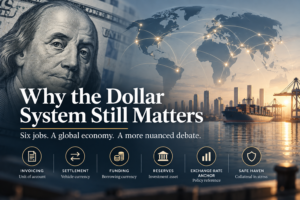
The September Shock? Why the 2026 BRICS Summit Could Become a Turning Point for the Dollar-Based Financial Order
Synopsis
The upcoming BRICS Summit in New Delhi could become a significant inflection point for the global financial order. Against rising U.S. debt, volatile Treasury yields, central-bank gold accumulation, sanctions on Russia and Iran, and intensifying geopolitical fragmentation, BRICS continues exploring local-currency settlement and alternative payment infrastructure.
The central thesis is not that BRICS will suddenly replace the U.S. dollar, but that the September summit could accelerate development of a parallel financial architecture that gradually reduces dependence on dollar-based settlement. Given already-sensitive global markets, even a credible roadmap could generate significant reactions across bonds, currencies, gold and commodities. Investors should therefore treat the summit as an important geopolitical tail risk rather than a predetermined de-dollarisation event.
A convergence investors should not ignore
Financial markets may be approaching one of those periods when developments that appear unrelated begin to form a much larger picture.
On September 12–13, 2026, leaders of the BRICS nations are scheduled to meet in New Delhi for the 18th BRICS Summit under India’s chairmanship. On the surface, this is another annual gathering of major emerging economies. Underneath, however, several unusually important forces are converging at precisely the same moment.
The United States is confronting a federal debt load above $40 trillion and significant volatility in its long-term government bond market. Central banks continue accumulating gold. Russia and Iran remain subject to extensive Western sanctions. Washington has dramatically intensified economic pressure on Iran and countries maintaining financial links with Tehran.
At the same time, BRICS has spent several years developing mechanisms intended to increase the use of national currencies, improve cross-border payments and make its members less dependent upon the existing international financial architecture.
And in August 2026, India’s diplomatic machinery has been unusually active.
None of these facts individually proves that BRICS is preparing a dramatic monetary announcement.
Taken together, however, they justify asking a much more consequential question:
Could the September BRICS Summit mark an acceleration in the development of a parallel financial settlement architecture — and, if so, are global markets adequately prepared for it?
That is the thesis investors should examine.
1. The warning was issued almost two years ago
The story arguably begins on November 30, 2024.
Then President-elect Donald Trump issued an unusually explicit warning to BRICS countries.
He demanded that BRICS members commit themselves to neither creating a new BRICS currency nor supporting another currency intended to replace the U.S. dollar. Otherwise, he threatened tariffs of 100%.
Trump wrote:
“We require a commitment from these Countries that they will neither create a new BRICS Currency, nor back any other Currency to replace the mighty U.S. Dollar…”
The threat was repeated after Trump returned to the White House in January 2025.
The significance of these statements was larger than the probability of a literal BRICS common currency.
Washington was effectively identifying de-dollarisation itself as an American strategic interest.
That distinction matters.
BRICS does not need to introduce a physical or digital currency called the “BRICS” to reduce dependence on the dollar.
It could instead create or connect infrastructure allowing trade to be settled directly in rupees, renminbi, rubles, dirhams, reais and other currencies.
That is a much more realistic possibility — and elements of precisely such an architecture are already under discussion.
Sources: Trump statement, November 30, 2024; subsequent Reuters reporting.
2. What BRICS is actually building
It is important to distinguish speculation from documented policy.
The evidence does not currently demonstrate that BRICS leaders have agreed to launch a common reserve currency in September.
What it does demonstrate is substantial work on the infrastructure beneath international payments.
The 2024 Kazan Declaration welcomed greater use of local currencies in transactions between BRICS members and their trading partners.
It encouraged stronger correspondent-banking networks and local-currency settlement through the BRICS Cross-Border Payments Initiative.
BRICS also agreed to study an independent cross-border settlement and depositary infrastructure known as BRICS Clear.
The declaration additionally instructed finance ministers and central-bank governors to continue examining local currencies, payment instruments and payment platforms.
Then came the 2025 Rio Declaration.
BRICS leaders again supported mechanisms for financing in local currencies and instructed finance ministers and central-bank governors to continue work on the BRICS Cross-Border Payments Initiative.
The declaration specifically acknowledged work by the BRICS Payment Task Force examining ways to increase interoperability between BRICS payment systems.
That work has continued into India’s 2026 presidency.
On August 11, RBI Governor Sanjay Malhotra confirmed that BRICS countries were discussing potential links between their fast-payment systems and central-bank digital currencies.
He emphasised that the proposals remained at the discussion stage.
But that qualification should not obscure the significance of the discussion itself.
The question is increasingly not:
“Will BRICS invent a new currency?”
The better question may be:
“How much international commerce could eventually be conducted without needing the dollar-based settlement infrastructure in the first place?”
3. August 2026 provided another important signal
Just weeks before the leaders’ summit, BRICS finance ministers and central-bank governors met in Jaipur.
According to the Bank of Russia, discussions included strengthening the global monetary and financial system and expanding the use of national currencies in mutual settlements.
That is a much more concrete development than speculation about a mythical overnight replacement for the dollar.
De-dollarisation is unlikely to occur through a single dramatic event.
It is more likely to proceed incrementally:
local-currency invoicing,
direct currency settlement,
interconnected domestic payment networks,
CBDC interoperability,
alternative correspondent-banking arrangements,
new clearing infrastructure,
and financing through institutions such as the New Development Bank.
Each individual step may appear modest.
Collectively, they could eventually create an alternative financial network capable of handling a meaningful portion of trade outside the traditional dollar-centric architecture.
4. India’s diplomatic activity deserves attention
Another piece of the puzzle is India’s unusually intensive diplomatic activity immediately ahead of the summit.
External Affairs Minister S. Jaishankar travelled to Moscow on August 23–24 and met Russian President Vladimir Putin, with regional and global issues forming part of the discussions. The visit comes immediately ahead of Putin’s expected trip to India for the BRICS summit.
National Security Adviser Ajit Doval has travelled to Beijing for another round of India-China strategic talks.
Commerce Minister Piyush Goyal has travelled to Japan seeking deeper investment and economic cooperation.
Finance Minister Nirmala Sitharaman, meanwhile, begins a Canada and United States visit on August 25 focused on investors, corporations and broader economic engagement.
These trips have their own stated bilateral purposes and should not automatically be interpreted as coordination for a BRICS monetary initiative.
Nevertheless, the timing is strategically interesting.
India is attempting to maintain relations simultaneously with Russia, China, Japan, Canada, the United States and the Gulf while preparing to chair perhaps the most geopolitically consequential BRICS summit of its presidency.
That suggests New Delhi is positioning itself not simply inside one geopolitical camp but as a balancing power across several.
And India could be critical to whatever happens next.
Russia and Iran have obvious incentives to develop alternatives to Western financial infrastructure because sanctions directly restrict their access to it.
China has strategic reasons to promote renminbi internationalisation.
India’s incentives are different. New Delhi benefits enormously from integration with Western capital markets and has little obvious interest in destroying the dollar system.
But India also has a strong interest in strategic autonomy.
A settlement architecture that provides additional options without formally declaring war on the dollar could therefore represent an area of overlapping BRICS interests.
5. Then there is Iran
The geopolitical environment makes the timing even more significant.
On August 24, the United States announced another major sanctions package against Iran and warned governments and businesses around the world to sever financial links with Tehran or risk American retaliation.
The measures target dozens of Iran-linked entities, while Washington is signalling that third countries maintaining financial relationships with Iran could themselves face consequences.
Iran is also a BRICS member.
And Iranian President Masoud Pezeshkian is expected in New Delhi for the September summit.
This creates an extraordinary geopolitical contradiction.
The United States is effectively telling the international financial system:
Maintain economic relations with Iran and you may lose access to parts of the American economic and financial system.
For countries already concerned about the extraterritorial reach of U.S. sanctions, that provides another incentive to explore infrastructure less exposed to American jurisdiction.
This does not prove that the latest Iran sanctions were designed primarily to pre-empt a BRICS announcement.
There is currently insufficient public evidence to make that claim.
But the timing means the sanctions could unintentionally strengthen the economic rationale for precisely the type of alternative settlement mechanisms BRICS has already been discussing.
That distinction is critical.
6. The weaponisation dilemma
America’s extraordinary financial power derives from several mutually reinforcing advantages.
The dollar dominates large parts of international trade and finance. U.S. capital markets are enormous and liquid. Treasury securities provide the world’s most important pool of high-quality collateral. Dollar clearing connects banks across continents.
This gives Washington something few countries in history have possessed:
the ability to transform financial infrastructure into geopolitical leverage.
Sanctions can therefore be remarkably powerful.
But there is a long-term paradox.
The more frequently access to a financial network becomes a geopolitical weapon, the greater the incentive for potential targets to construct alternatives to that network.
For years, the enormous cost and complexity of replacing dollar infrastructure limited that possibility.
BRICS expansion changes the calculation somewhat.
The grouping now contains major commodity producers, manufacturing powers, enormous consumer markets, important energy exporters and several countries possessing sophisticated domestic payment infrastructure.
The relevant risk is therefore not that BRICS suddenly replaces the dollar.
It is that the economic justification for constructing a second network becomes progressively stronger.
7. The Treasury market makes this moment particularly sensitive
Under normal circumstances, markets might treat a BRICS payment announcement as a long-duration geopolitical development.
But these are not normal circumstances.
U.S. federal debt has now surpassed $40 trillion, while long-term Treasury yields have recently reached levels unseen in many years.
The 30-year Treasury yield recently moved above 5.3%, while the Treasury Department has expanded long-dated bond buybacks as authorities attempt to improve market functioning and address pressure at the long end.
Recent Treasury auctions have also attracted scrutiny. An August 19 auction of 20-year bonds required a small yield concession relative to the pre-auction market. Importantly, however, the broader bidding statistics were reasonably healthy, so describing Treasury demand as collapsing would overstate the evidence.
Similarly, foreign demand presents a nuanced picture.
Foreign Treasury holdings declined in June from approximately $9.37 trillion to $9.30 trillion, with Japan, China and the United Kingdom reducing holdings.
China’s holdings were approximately $633 billion in June 2026 compared with roughly $731 billion a year earlier.
Yet the United States still recorded substantial foreign capital inflows in June. Treasury data show $133.5 billion of total net TIC inflows and $207.1 billion of foreign purchases of long-term U.S. securities during the month.
So the evidence does not support a simplistic “foreigners have stopped buying America” narrative.
It supports something subtler:
America must finance an unprecedented stock of debt at a time when some traditional official buyers are becoming less dominant and investors are demanding greater compensation for holding long-duration sovereign risk.
That makes any structural challenge to global dollar demand more important than it might otherwise have been.
8. Follow the gold
There is another signal coming from global reserve managers.
Gold.
According to the World Gold Council, central banks purchased another 863 tonnes of gold in 2025 after three consecutive years in which annual official-sector demand had exceeded 1,000 tonnes.
The World Gold Council’s 2026 survey provides an even more revealing picture.
Some 89% of surveyed reserve managers expect global central-bank gold holdings to rise over the next twelve months, while a record 45% expect their own institutions to increase their gold holdings.
Furthermore, 83% expect gold to account for a greater proportion of global reserves five years from now.
Gold has one characteristic that becomes particularly attractive in a fragmented geopolitical system:
it is nobody else’s liability.
It cannot be defaulted upon by a foreign government.
It does not require another country’s banking system to exist.
And physical gold held domestically is extremely difficult for another country to sanction.
Central-bank gold accumulation therefore does not prove an imminent collapse in dollar confidence.
But it is consistent with a broader trend toward reserve diversification and geopolitical insurance.
9. What could actually be announced in New Delhi?
The dramatic scenario would be a fully fledged BRICS common currency.
That remains unlikely based on publicly available evidence.
Creating a genuine common currency would require extraordinary coordination over monetary policy, capital flows, exchange rates, reserve management and political governance among countries with profoundly different economic structures.
A more realistic announcement would involve infrastructure rather than currency.
Potential developments could include:
- a formal roadmap for connecting BRICS fast-payment systems;
- further development of the BRICS Cross-Border Payments Initiative;
- interoperability between central-bank digital currencies;
- expanded mechanisms for settling bilateral trade in national currencies;
- progress toward BRICS Clear or another clearing/depository mechanism;
- greater local-currency financing through the New Development Bank;
- commodity-market infrastructure that encourages non-dollar settlement;
- or a technical framework that allows additional countries eventually to participate.
The important point is that none of these requires BRICS to declare a new currency.
And that could make such initiatives considerably easier to implement politically.
10. Three scenarios for September
Scenario 1 — Incremental progress
This is probably the least disruptive outcome.
The summit communique repeats previous language about local currencies, payment efficiency and financial-system reform while creating additional working groups or technical studies.
Markets largely ignore it.
The dollar remains dominant and Treasuries trade primarily on inflation, fiscal policy and Federal Reserve expectations.
Scenario 2 — A concrete BRICS settlement framework
BRICS leaders announce a specific roadmap for connecting national payment systems, facilitating local-currency settlement or interoperating CBDCs.
This would not replace SWIFT immediately.
But markets could interpret it as the first credible institutional architecture capable of gradually reducing dependence upon dollar-based correspondent banking for intra-BRICS commerce.
The immediate market reaction could be modest, but the strategic significance would be considerable.
Scenario 3 — The September shock
The tail-risk scenario would involve something materially larger:
a functioning multilateral settlement platform;
a commodity-linked settlement mechanism;
a BRICS clearing institution;
a broad digital settlement unit;
or a timetable for migrating a significant share of intra-BRICS trade away from dollar settlement.
If announced alongside commitments from major commodity exporters and importers, markets could suddenly be forced to reconsider the pace of de-dollarisation.
This would not mean the dollar loses reserve-currency status overnight.
But financial markets price changes at the margin.
If investors concluded that future structural demand for dollars and Treasuries could be lower than previously assumed, the adjustment could affect currencies, sovereign bonds, precious metals, commodities and emerging-market assets simultaneously.
11. Why the market reaction could matter more than the announcement
The greatest risk may not be the technical substance of a BRICS announcement.
It may be where the global financial system is starting from when the announcement arrives.
Consider the starting conditions:
U.S. federal debt above $40 trillion.
Long-duration Treasury yields around multi-year highs.
Persistent fiscal deficits.
Greater central-bank interest in gold.
War and sanctions involving Iran.
Continuing sanctions against Russia.
Increasing geopolitical fragmentation.
BRICS discussions about national-currency settlement.
CBDC and fast-payment-system interoperability under consideration.
And an American administration explicitly willing to threaten economic retaliation against countries challenging dollar primacy.
In isolation, each is manageable.
Together, they create the possibility of nonlinear market reactions.
Financial crises rarely occur because investors discover a fact nobody knew.
They often occur because a new event suddenly changes the interpretation of facts everybody already knew.
12. What would invalidate the thesis?
A credible macro thesis must also identify what could prove it wrong.
Several developments would weaken this argument significantly.
First, the September declaration could contain nothing beyond the incremental language used in previous BRICS communiques.
Second, India could actively resist any proposal that appears explicitly anti-dollar or anti-Western.
Third, disagreements between China and India could prevent meaningful financial integration.
Fourth, BRICS members may find that connecting domestic payment and CBDC systems is technically and legally far more difficult than political declarations suggest.
Fifth, global investors could continue increasing Treasury exposure despite reserve diversification because no alternative market approaches the depth, liquidity and legal infrastructure of U.S. financial markets.
And finally, de-dollarisation may continue for decades without producing anything resembling a dollar crisis.
These are substantial counterarguments.
The dollar’s network effects remain enormous.
13. The dollar does not need to collapse for this to matter
This is perhaps the most important point.
The investment thesis should not be:
“BRICS will destroy the dollar in September.”
That is neither supported by current evidence nor necessary for the thesis.
A much more defensible argument is:
The world may be moving from a predominantly dollar-centric financial architecture toward a more fragmented, multipolar settlement system, and the September 2026 BRICS Summit could represent an important acceleration point in that transition.
The dollar could remain the world’s dominant reserve currency for decades while simultaneously losing market share at the margin.
SWIFT could remain enormously important while alternative settlement networks grow beside it.
Treasuries could remain the world’s largest sovereign bond market while investors demand structurally higher yields to absorb expanding issuance.
Gold could coexist with the dollar while becoming a larger proportion of central-bank reserves.
These outcomes are not mutually exclusive.
Conclusion: September 12–13 deserves a place on every macro investor’s calendar
There is currently no public evidence proving that BRICS will unveil a revolutionary currency or payment system at its New Delhi summit.
But there is enough evidence to take the possibility of a meaningful financial announcement seriously.
BRICS has spent several years discussing local-currency settlement.
It has established a Cross-Border Payments Initiative.
It has examined payment-system interoperability.
It has discussed alternative settlement and depositary infrastructure.
Its central bankers are now openly discussing linking fast-payment systems and CBDCs.
Its finance officials have continued discussing national-currency settlement in 2026.
All of this is happening while American fiscal vulnerabilities are attracting increasing market attention, central banks are accumulating gold, Washington is escalating financial pressure on Iran, and geopolitical fragmentation is intensifying.
The timing may ultimately prove coincidental.
The September summit may produce little more than another declaration.
But investors should distinguish probability from consequence.
Even if the probability of a genuinely transformative BRICS announcement remains relatively low, the potential consequences are sufficiently large that the event deserves attention.
The most important market signal would not necessarily be the words “BRICS currency.”
Watch instead for phrases such as:
payment-system interoperability, local-currency settlement, CBDC bridges, clearing infrastructure, correspondent banking, commodity settlement, BRICS Clear, digital settlement units and expansion to third countries.
Those are the mechanisms through which a parallel financial architecture would actually emerge.
For investors, therefore, the sensible response is not panic.
It is preparation.
Exposure to duration risk, currencies, gold, commodities and geographically concentrated equity positions should be understood before the summit rather than after it. Hedging, where appropriate to an investor’s objectives and risk tolerance, is ultimately about surviving low-probability, high-impact outcomes rather than predicting them with certainty.
September 12–13 may pass quietly.
But if New Delhi produces something larger than markets expect, the significance will extend far beyond BRICS.
It could mark the moment when de-dollarisation stopped being primarily a geopolitical debate and began becoming a piece of investable financial infrastructure.
Key references and further reading
BRICS 2026 Summit: Government of India confirms that the 18th BRICS Summit will be held in New Delhi on September 12–13, 2026.
Trump’s BRICS warning: Donald Trump’s November 30, 2024 statement threatening 100% tariffs against BRICS members pursuing a currency intended to replace the dollar.
2024 Kazan Declaration: Local currencies, BRICS Cross-Border Payments Initiative and examination of BRICS Clear.
2025 Rio Declaration: Cross-Border Payments Initiative, BRICS Payment Task Force, local-currency financing and payment-system interoperability.
2026 BRICS financial discussions: Bank of Russia report on the August meeting of BRICS finance ministers and central-bank governors.
RBI on payments and CBDCs: RBI Governor Sanjay Malhotra’s August 2026 comments concerning possible connections between BRICS fast-payment systems and CBDCs.
U.S. Treasury capital flows: June 2026 Treasury International Capital data.
Central-bank gold: World Gold Council 2025 Gold Demand Trends and 2026 Central Bank Gold Reserves Survey.
Iran sanctions: Reporting on the August 24, 2026 U.S. sanctions escalation and warning to countries maintaining financial relationships with Iran.
Indian diplomatic activity: Recent engagements involving Jaishankar, Doval, Goyal and Sitharaman.
Disclaimer
This article presents a geopolitical and macroeconomic scenario analysis, not a prediction that BRICS has decided to introduce a new currency or settlement system. Several scenarios discussed above are explicitly speculative. Nothing in this article constitutes investment advice.
The core concepts, intellectual frameworks, and primary conclusions presented in this post—whether exploring macroeconomics, technology, governance, or philosophical inquiry—are the result of extensive synthesis, wide-ranging study, and the author’s personal observations of global developments and literature. In alignment with modern digital workflows, advanced generative AI were utilized as a collaborative tool to assist in refining prose, structuring editorial layouts, and drafting supporting conceptual imagery. All final content is personally curated, reviewed, and approved by the author.