The September Shock That Wasn’t
Synopsis
The 18th BRICS Summit did not produce a parallel settlement system, a common currency, or a timetable for moving trade off the dollar. It produced the Adaptive Polycentric Framework’s base rate: states keep what still works and add options where they see risk. The New Delhi Declaration stayed at study-and-discuss on payments. The sidelines were more revealing. India–Russia already settles most trade outside the dollar and used the weekend to set a $100 billion target for 2030. India–UAE already has CEPA, INR–AED invoicing and common-law structures that do not wait for eleven members. India–China repaired politics and trade access, not plumbing. Xi previewed a 2027 agenda of AI, special economic zones and services trade — industrial public goods, not a currency. Scenario 1 is not a rhetorical pivot. It is the pre-published falsifiers, marked to market.
The useful question after New Delhi is not whether BRICS “failed to dethrone the dollar.” It is which of the dollar’s six jobs moved, in which corridor, at what scale — and who prevented a theatrical club-wide result.
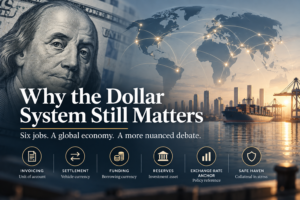
That is the TGGR method. The Great Global Re-balancing does not treat the dollar as a single object that either survives or collapses. It treats the international system as seven interacting layers — monetary, financial, institutional, physical infrastructure, energy, strategic resources, and geopolitics — and asks where states are diversifying dependencies. The opening series essay put the same discipline on the currency itself. The dollar does six jobs: invoicing (unit of account), settlement (vehicle currency), funding (borrowing currency), reserves (investment asset), exchange-rate anchor, and safe-haven/collateral. A rival can gain in one and remain irrelevant in another.[1]
A pre-summit note asked whether 12–13 September would accelerate a parallel settlement architecture enough to matter at the margin for bonds, currencies and gold. It also published the tests that would invalidate a shock reading: incremental language, Indian resistance to an anti-dollar frame, the technical hardness of linking systems, and the dollar’s remaining network effects.[2] Those tests were not decoration. They were the invalidation criteria. What follows is the mark-to-market.
The score
Three scenarios were on the table.
Scenario 1: incremental language, more technical work, markets still pricing Treasuries on fiscal path, inflation and growth.
Scenario 2: a concrete framework — named rails, a clearing vehicle, a CBDC corridor.
Scenario 3: a functioning multilateral platform or a timetable to migrate intra-BRICS trade.
Scenario 1 arrived at club level. India’s Ministry of External Affairs said there is “no proposal in the BRICS for a BRICS currency as of now.” Local-currency settlement was described as a way to cut transaction costs and as complementary to the global system.[3]
That is not a surprise if the working hypothesis is the TGGR one: exclusivity erodes function by function, corridor by corridor, while private vehicle-currency use and funding depth stay dollar-centred until alternatives show sustained operating volume. New Delhi produced a declaration. It did not produce new volume. The volume that exists sits in bilateral energy, sanctions and mid-shore corridors that predate the summit.
1. Why anyone thought a shock was possible
Two pressures sit underneath every BRICS finance communiqué. They create the analytical tension. They do not, by themselves, produce architecture.
The first is the weaponisation dilemma. America’s financial power comes from the fact that invoicing, settlement, funding, reserves and collateral still run, to a remarkable degree, through the same currency and the same legal system. That makes sanctions effective. It also gives targeted states, and states that fear becoming targets, a reason to build a second set of pipes. Russia and Iran live inside that incentive. An enlarged BRICS contains commodity exporters, manufacturers and large consumer markets that can, in principle, settle more with one another without a dollar correspondent at the centre of every trade.
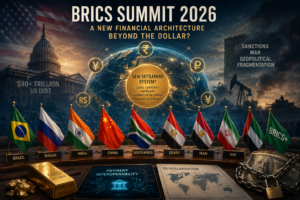
The second is the official-sector search for insurance against a very large stock of U.S. sovereign debt. Federal debt above $40 trillion, a demanding long end of the Treasury curve, and several years of heavy central-bank gold buying do not prove that foreigners have “stopped buying America.” They do prove that reserve managers want assets that are nobody else’s liability. Gold is the cleanest expression of that instinct in the reserve job. Local-currency settlement is the messier expression of the same instinct in the settlement job.
Neither pressure required a summit announcement to exist. Both explain why New Delhi was watched. Neither was converted into a club-wide system. That is what the scorecard below records.
APF scorecard: expectation, outcome, base rate
| Monetary | New unit of account, reserve-pooling leap, or a commodity-linked settlement token | No new currency; CRA made more flexible; gold left as a national reserve choice, not a BRICS asset | Yes. The reserve job is diversifying into physical gold, not a synthetic bloc unit |
| Financial | Connected payment rails, CBDC bridges, BRICS Clear, a live bloc corridor | Joint text stayed at study-and-discuss, “no one-size-fits-all.” India–Russia and Russia–China already settle most trade outside the dollar. India–China added no rail. India–UAE already invoices and structures capital outside a BRICS vehicle | Yes. Settlement inroads are bilateral. The funding and collateral jobs were not touched |
| Institutional | Operational New Investment Platform; NDB as a parallel reserve-system actor | NDB told to expand local-currency financing; Knowledge Portal launched; NIP remains a study group; IMF/WB/WTO reform restated; Putin pushed a broader NDB role on the margins | Partial. Institutions thickened, not substituted |
| Physical infrastructure | Corridor-scale project pipeline tied to non-dollar finance | PPP and disaster-resilience toolkits; BRICS–NDB Knowledge Portal; Putin restated the International North–South Transport Corridor and Arctic logistics — intent, not a financed map | Yes. Capacity-building and bilateral logistics talk |
| Energy | Local-currency oil and gas settlement as a BRICS project, or a pricing basket | No basket. Declaration defended a diversified mix and undisrupted flows. India–Russia crude remains the live non-dollar energy corridor | Yes. Energy-to-money transmission is bilateral |
| Strategic resources | Commodity platform that prices and clears outside the dollar | Grain Exchange still “further discussions on modalities.” Critical minerals as sovereignty language in the text; India–Russia minerals on the 2030 agenda | Yes. Resource politics without a market |
| Geopolitics | A bloc declaration that reads as monetary non-alignment | Loud on unilateral tariffs and coercive sanctions. West Asia language unnamed after an Iran–UAE compromise. Modi–Xi: “differences should not become disputes,” but India made border peace a precondition and China wanted “parallel” progress | Mixed. Political grievance rose; monetary theatre did not |
One loud layer does not move the other six. A busy bilateral calendar does not convert Scenario 1 into Scenario 2.
The structural divergence is simple. The geopolitical layer accelerated into official grievance — tariffs, secondary sanctions, unnamed wars, a rare Iran–UAE encounter that existed only to keep the text alive. The financial and monetary layers stayed where the pre-summit falsifiers said they would stay: technical, voluntary, member-driven, and anchored to national law. That is not indecision. It is the design constraint of an eleven-member club that includes both sanctioned energy exporters and a chair still deep inside dollar funding and hedging markets.
2. The club text and the corridor layer
APF does not expect an eleven-member launch. It expects options to appear first in pairs.
Two days before leaders met, reporting on India’s chair position was already explicit: New Delhi would back central-bank digital currencies for bilateral settlement and would not sponsor a unified bloc-wide payments network that could be read as a challenge to the dollar.[4] The declaration followed that doctrine. The New Delhi Declaration and the 10 September finance ministers’ statement acknowledge the Payment Task Force, record work on interoperability of payment and messaging channels, note discussions on local-currency settlement, and then add the two hedges that define the file: “respecting national priorities” and “no one-size-fits-all.”[5]
The corridors were already ahead of the club.
India–Russia. On 11 September, before the leaders’ session, Prime Minister Narendra Modi and President Vladimir Putin agreed to push bilateral trade to $100 billion by 2030 and to implement the Programme for Economic Cooperation 2030, covering energy, defence, critical minerals, fertilisers, civil nuclear cooperation and logistics. Putin invited Modi to Russia for the 24th annual summit.[6] That is a volume and industrial agenda on a corridor that is already mostly off the dollar. Reporting immediately before the summit, citing Sberbank India’s India head, put around 96 per cent of India–Russia trade on established rupee–ruble mechanisms; Russia–China trade is already settled largely in yuan and rubles.[4] The constraint is not the absence of a BRICS currency. It is the pile of rupees generated by discounted oil that Russia cannot easily spend in India, and the deficit New Delhi wants to narrow by selling more into the Russian market. The weekend raised the target. It did not inaugurate the rail.
India–China. On 12 September, in Xi Jinping’s first visit to India since 2019, the two leaders agreed that differences should not become disputes and that structural trade imbalance, supply chains and market access needed work. They also committed to a “fair, reasonable, and mutually acceptable” boundary settlement. The readouts still diverge on sequence. India said peace and tranquillity on the border remain “an essential basis” for the wider relationship. China said the relationship and the boundary question should advance in “parallel, mutually reinforcing” fashion.[7] That is geopolitical stabilisation with a trade-imbalance annex. It is not a settlement compact. A bloc payments network that includes both capitals needs data-sharing, some market access and a minimum of operational trust. The bilateral did not supply those.
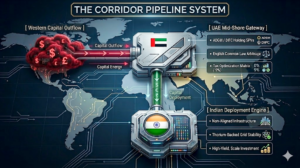
India–UAE. This corridor did not need the summit to exist, which is why it is easy to miss in a communiqué review and why it belongs on the same table. India and the UAE already invoice in rupees and dirhams where it suits the trade, route goods and services through the Comprehensive Economic Partnership Agreement, and park deployable capital in ADGM and DIFC common-law structures. The weekend added no new multilateral vehicle. What it added was geopolitical insulation: the UAE could sit in the same hall as Iran, accept unnamed language on West Asia, and leave the private mid-shore channel untouched. That is the point of an agile connector. Settlement and structuring here do not wait for eleven signatures.
Russia–China. No new design was required. The corridor already runs in national currencies. The weekend gave it political cover inside an Indian-hosted text, not a new pipe.
So the weekend splits cleanly:
| Corridor | Settlement job today | What the weekend added |
|---|---|---|
| India–Russia | Largely local-currency; oil-driven imbalance | $100 billion target and 2030 economic programme; no new rail |
| Russia–China | Already mostly CNY/RUB | Political cover |
| India–China | Still dollar-heavy; large Indian deficit | Access and supply-chain talk; no settlement deal |
| India–UAE | INR–AED invoicing, CEPA routing, ADGM/DIFC SPVs | Geopolitical insulation; private capital deployment still does not require multilateral consensus |
| 11-member BRICS | Task force and hedges | Language only |
The dollar was not challenged by a BRICS institution last weekend. It is already being routed around in energy, sanctions and mid-shore corridors, by national systems, at national speed. The joint declaration refused to federalise that practice.
3. 2026 was the brake. 2027 is the first plausible window.
Middle powers are the connective tissue in this framework. They do not choose a bloc. They hold several systems open at once.
India, in the 2026 chair, behaved as a neutral-infrastructure brake. It needs Western capital markets, technology and export demand. It also wants strategic autonomy, cheaper intra-emerging-market settlement, and a louder voice in the IMF, the World Bank and the UN. Those two facts produce a narrow preference: rails that cut cost and add optionality, not a political break with the currency in which most of India’s external finance, invoicing and hedging still lives. The 10 September briefing and the 12 September declaration are the same sentence in two registers. An enlarged BRICS cannot move faster than its most system-integrated chair will allow.
The UAE, on the same axis, moves differently across the layers. Where India treats BRICS payments as a complementary public good, the UAE builds autonomous capacity in energy and in its own financial centres and does not need eleven members to agree before it tests settlement options. One pole supplies speed and hard-asset optionality. The other supplies scale, neutrality and political cover. Capital that wants insulation from a weaponised dollar system does not need BRICS to become a currency union. It needs a jurisdiction that can receive funds and an economy large enough to deploy them.
China’s 2027 chairship is a different institutional fact. It is the first plausible window in which the Indian brake comes off.
The evidence for that is not a rumour about a BRICS currency. It is what Xi tabled in New Delhi. He called for a “Greater BRICS” of stable industrial and supply chains and a more integrated market, and proposed that China lead a BRICS AI Open Source Zone, a Special Economic Zone partnership, and a BRICS Services Trade Forum in 2027.[8] Those are industrial and digital public goods. They are not a settlement architecture. They do show a chair with an internationalisation and production agenda, payment-system depth, and a commodity-import book large enough to push BPTF work, NDB local-currency lending and depositary talk from “study” toward pilots.
That is not a forecast of Scenario 3. China still needs dollar commodity markets, still holds a large Treasury book, and still faces partners — India first among them — who will not accept a renminbi-centred design as the price of BRICS membership. What changes is the chair’s incentive. A neutral-infrastructure host maximises consensus and minimises symbolism. A host with a live internationalisation agenda maximises the chance that the financial and institutional layers harden.
The APF question does not change with the chair. Which layer, which job, what volume. The political possibility of a harder answer does.
4. Autopsy: what still stands, and what the market should drop
Scenario 1 is not a walk-back of the 6 September essay. That essay separated identity from ideas. It named the shock as one scenario among three, and it named the conditions under which the shock reading would fail. Incremental language, an Indian chair unwilling to host an anti-dollar frame, the hardness of linking payment systems, and the dollar’s network effects were those conditions.[2] They arrived. Marking the summit to those tests is the invalidation principle applied in public, not a change of mind after the fact.
What still stands is the medium-term file. Local-currency invoicing, payment-system links, NDB lending in members’ own currencies, and a thicker CRA can reduce dollar use in specific corridors without anyone announcing a rival reserve currency. Sanctions and tariff risk keep the incentive alive. Official gold buying remains the cleanest hedge in the reserve job. India will use local-currency settlement where it cuts cost or keeps oil moving. It will not, in 2026, sponsor a network that reads as a choice of camp.
What should be dropped are the misconceptions the weekend is already being asked to carry.
The Modi–Xi meeting is not a financial event. It is a geopolitical stabilisation meeting with a trade-imbalance annex.
The $100 billion India–Russia target is not new plumbing. It is a volume goal on an existing sanctioned-energy rail.
“BRICS Clear” is a research item until a later text names an institution and gives it a legal basis.
A busy sideline calendar is not Scenario 2.
“Turning point” was a claim about pace. Pace is what the club text did not change.
5. Operating monitor
The series rule is blunt. When someone says the dollar’s share fell, name the job. Mapped onto the six jobs, New Delhi left the following residue:
- Invoicing / unit of account. Still dollar-dominated outside sanctioned bilateral trade. No BRICS unit.
- Settlement / vehicle currency. Marginal non-dollar inroads in India–Russia and Russia–China. India–UAE already had optionality. The club did not federalise any of it.
- Funding / borrowing currency. Unchallenged. No deep non-dollar issuance market was offered, let alone used.
- Reserves / investment asset. Diversification continues through national gold holdings, not a synthetic BRICS reserve asset.
- Exchange-rate anchor. Untouched.
- Safe-haven / collateral. Untouched. BRICS showed no capacity to offer deep, liquid, non-dollar repo or sovereign collateral that a dealer would post on a bad day.
Watch thresholds, not adjectives.
- A live Payment Task Force corridor with measurable cost and settlement time against the dollar route it is meant to complement.
- India–Russia finding a use for surplus rupees that turns the oil rail into two-way trade rather than a blocked balance.
- NDB local-currency lending large enough, and repeated enough, to count as a funding channel rather than a pilot.
- CRA onboarding that turns a narrow safety net into something an enlarged grouping can use.
- A named settlement or depositary arrangement with a legal basis.
- A CBDC or fast-payment link that handles commercial payments between members who are not already forced off SWIFT.
- Energy invoices that settle, at scale, outside the dollar in corridors other than Russia’s.
- Any 2027 Chinese-chair text that converts “encourage continued discussions” into a dated pilot, a legal vehicle, or a renminbi-centred corridor that other members actually use.
Until one of those exists, the private vehicle, funding and collateral jobs remain dollar-centred. Treasuries will still be priced first on issuance, inflation and growth. Gold will still be accumulated as insurance. The dollar can lose exclusivity at the edges and keep the core.
Conclusion
New Delhi did not invalidate the re-balancing. It invalidated the compression of that re-balancing into two days in a single hall.
The geopolitical layer of APF got louder. The financial layer of the club got another workstream. The financial layer of three corridors — sanctioned energy in the north, mid-shore capital in the Gulf, and a still-dollar India–China trade book — kept doing what national incentives had already forced or allowed them to do. The monetary layer did not get a new unit. The funding and collateral jobs were not on the agenda.
India used the chair as a neutral-infrastructure brake. China used the same weekend to preview an industrial and digital 2027. The UAE did not need the weekend to keep its mid-shore channel open.
The September test was real. The shock was not. The base rate — keep what works, build alternatives where risk is visible, measure progress job by job and corridor by corridor — is the one the documents, the sidelines and the pre-published falsifiers all confirmed.
Sources
- Jayesh Rawal, “Why the Dollar System Still Matters,” TGGR Research, 6 September 2026; and “The Great Global Re-balancing.” Six jobs and the APF checklist.
https://jrawal.com/why-the-dollar-system-still-matters/
https://jrawal.com/the-great-global-re-balancing/ - Jayesh Rawal, “The September Shock? Why the 2026 BRICS Summit Could Become a Turning Point for the Dollar-Based Financial Order,” 6 September 2026. Scenarios and falsifiers.
https://jrawal.com/the-september-shock-why-the-2026-brics-summit-could-become-a-turning-point-for-the-dollar-based-financial-order/ - “No proposal for BRICS currency as of now, says MEA,” The Hindu Business Line, 13 September 2026.
https://www.thehindubusinessline.com/economy/no-proposal-for-brics-currency-as-of-now-says-mea/article71460405.ece - Anup Roy and Sudhi Ranjan Sen, “India backs CBDCs for Brics payments, rules out bloc-wide network,” Business Standard (Bloomberg), 10 September 2026. Chair position on CBDCs; Sberbank India comment on rupee–ruble share of India–Russia trade.
https://www.business-standard.com/finance/news/india-backs-cbdcs-for-brics-payments-rules-out-bloc-wide-network-126091000273_1.html - Government of India, Ministry of External Affairs, “BRICS New Delhi Declaration: Building for Resilience, Innovation, Cooperation and Sustainability (September 12, 2026),” especially paragraphs 20–22, 90, 93–97 and 115; and BRICS Finance Ministers and Central Bank Governors, Joint Statement, Mumbai, 10 September 2026, especially paragraphs 11–14, 22 and 24–25.
https://www.mea.gov.in/bilateral-documents?dtl/41776
https://www.brics2026.gov.in/ - “Modi, Putin seek stronger ties as Russia calls for BRICS to counter West,” Reuters, 11 September 2026; “BRICS 2026: PM Modi sits down with Putin, talks $100 bn trade by 2030,” The Economic Times, 12 September 2026.
https://www.reuters.com/business/aerospace-defense/modi-putin-hold-talks-new-delhi-trade-defence-2026-09-11/
https://m.economictimes.com/news/economy/foreign-trade/brics-2026-pm-modi-sits-down-with-putin-talks-100-bn-trade-by-2030-plan-to-deepen-defence-energy-nuclear-ties/articleshow/134086738.cms - Ministry of External Affairs, “Prime Minister’s bilateral meeting with Chinese President Xi Jinping (September 12, 2026)”; Chinese readout of “parallel, mutually reinforcing progress” as reported by CNA and India Today, 12–13 September 2026.
https://www.mea.gov.in/press-releases?dtl/41778/Prime_Ministers_bilateral_meeting_with_Chinese_President_Xi_Jinping_September_12_2026
https://www.channelnewsasia.com/asia/xi-modi-india-china-brics-summit-6381056
https://www.indiatoday.in/india/story/modi-xi-meeting-brics-india-china-differ-on-border-peace-bilateral-ties-2993427-2026-09-12 - “Xi unveils AI and trade initiatives as China moves to strengthen ‘Greater Brics’,” The Independent, 13 September 2026.
https://www.independent.co.uk/asia/india/brics-xi-jinping-modi-putin-india-china-russia-b3049337.html
Also used
Iran–UAE drafting compromise: Suhasini Haidar, The Hindu, 12 September 2026.
https://www.thehindu.com/news/national/brics-issues-new-delhi-declaration-as-uae-and-iran-back-down-from-tough-positions/article71460749.ece
Sideline colour on NDB, INSTC/Arctic, and the rupee oil-surplus constraint: Ben Aris, bne IntelliNews, 13 September 2026.
https://www.intellinews.com/brics-gets-its-declaration-and-putin-gets-the-summit-he-wanted-467443/
Ukraine “good offices”: Times of India, 13 September 2026.
https://timesofindia.indiatimes.com/india/modi-xis-ukraine-offer-to-putin-strong-message-to-west-new-brics-playbook-key-outcomes-of-summit/articleshow/134197086.cms
India–UAE corridor background: Jayesh Rawal, “The Multipolar Sanctuary.”
https://jrawal.com/the-multipolar-sanctuary-capital-realignment-and-wealth-preservation-across-the-uae-india-geopolitical-axis/
Disclaimer
The core concepts, intellectual frameworks, and primary conclusions presented in this post—whether exploring macroeconomics, technology, governance, or philosophical inquiry—are the result of extensive synthesis, wide-ranging study, and the author’s personal observations of global developments and literature. In alignment with modern digital workflows, advanced generative AI were utilized as a collaborative tool to assist in refining prose, structuring editorial layouts, and drafting supporting conceptual imagery. All final content is personally curated, reviewed, and approved by the author.