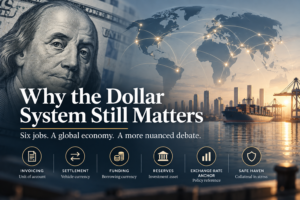
The Multipolar Sanctuary: Capital Realignment and Wealth Preservation Across the UAE-India Geopolitical Axis
This master thesis investigates how skyrocketing Western sovereign debt, NATO budget exhaustion from regional proxy conflicts, and East Asian supply-chain risks are actively fracturing the US dollar's status as the global reserve currency. It deconstructs the historic surge in global gold prices and unprecedented central bank accumulation as silent, sovereign actions taken by non-aligned nations to aggressively de-risk their wealth without publicly telegraphing a loss of confidence in Washington. Ultimately, the paper demonstrates how global capital can bypass weaponized banking systems by routing through parallel BRICS payment infrastructure (BRICS Pay and Project mBridge) into secure UAE common-law structures (ADGM/DIFC) that deploy directly into India's hyper-growth, strictly neutral economy.
Overview
This structural decay is signaled most clearly by an unprecedented, record-shattering supercycle in gold prices, driven by aggressive, off-market physical accumulation by central banks outside the West. For the first time in modern monetary history, official gold holdings worldwide are reaching value parity with foreign-held U.S. Treasury securities, proving that the official sector is methodically shifting toward hard assets free from counterparty or political risk. Crucially, because many of these countries depend fundamentally on US trade networks or security umbrellas, they maintain a delicate double-game. They practice a polite, calculated diplomatic silence to avoid public friction with Washington while privately building physical bullion bunkers—de-risking their sovereign wealth out of sight.
As institutional asset managers and private family offices follow these quiet sovereign footprints away from traditional Western networks, the UAE-India Geopolitical Axis has emerged as the premier parallel safe haven. While the West faces systemic overstretch—intensified by budgetary strains within NATO, a widening regional war involving Iran, and the destabilizing shadow of East Asian flashpoints—the UAE and India have executed a masterful series of sovereign realignments. By decoupling from legacy energy cartels like OPEC, pioneering revolutionary thorium-based nuclear programs to achieve absolute energy independence, and spearheading next-generation payment networks like BRICS Pay and Project mBridge, this corridor provides an unassailable sanctuary where fluid compliance frameworks act as the ultimate defensive shield for multi-generational wealth preservation.
Part 1: The Sovereign Realignment – Capital Migration in a Fracturing Global Order
The foundational architecture of global wealth preservation is undergoing a profound structural transformation. For decades, traditional wealth management relied on a standardized template: capital generated anywhere in the world was routinely routed into Western financial ecosystems—primarily via London, New York, Zurich, or Frankfurt—under the baseline assumption that these jurisdictions offered absolute legal sanctity, deep liquidity, and unmatched political permanence. Today, that foundational assumption has completely fractured. Wealth preservation has fundamentally outgrown standard portfolio allocation theories; asset safety is no longer a localized micro-investment problem, but a macro-survival challenge directly contingent on escaping systemic geographical, political, and monetary decay.
The most damning evidence of this systemic decay is not found in public political declarations, but in the silent, unmistakable actions recorded on the balance sheets of the world's central banks. Over the past 24 months, gold has broken free from its historical trading bands to engage in a historic, structural bull run. Entering 2024 at roughly $2,040 per ounce, the precious metal surged relentlessly through 2025, breaching the $4,000 threshold as macro vulnerabilities intensified and peaking at an all-time high of $5,602 per ounce earlier this year. Even with recent consolidations amid tight monetary policy, spot gold continues to trade at an elevated $4,512 per ounce (as on 29 May 2026), confirming that the global financial elite are methodically swapping paper fiat reserves for physical bullion. This gold rush represents a quiet, collective vote of no confidence in the long-term stability and security of the US dollar.
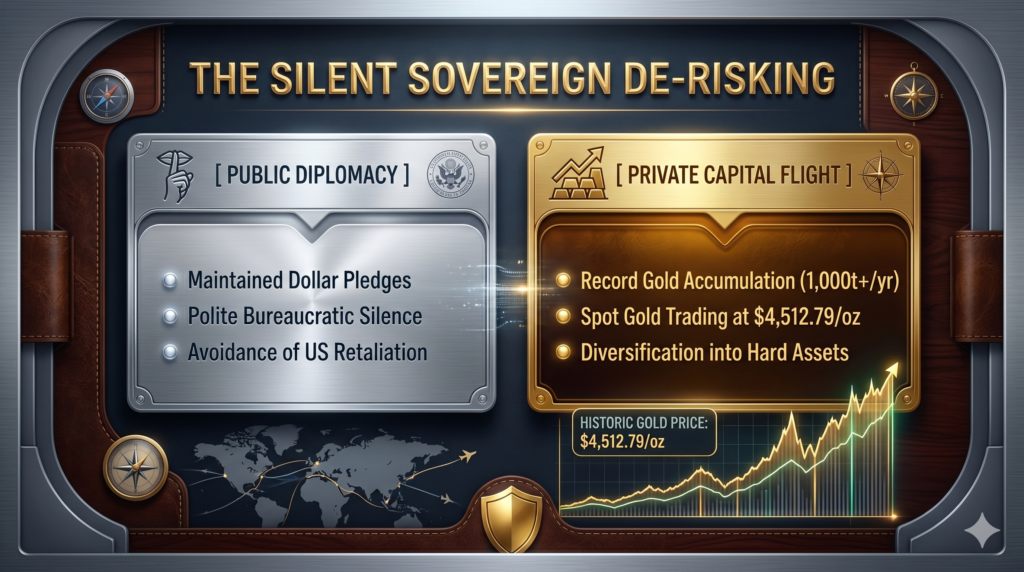
Crucially, because many of these accumulating nations depend fundamentally on US trade networks, tech ecosystems, or security umbrellas, they must practice a delicate, calculated double-game. They cannot afford to openly declare they are diversifying away from the greenback without risking immediate diplomatic alienation or aggressive economic retaliation from Washington. Consequently, this massive shift into physical bullion serves as a silent, non-aligned insurance policy—a method to aggressively de-risk sovereign wealth entirely out of sight of weaponized Western banking rails while maintaining a veneer of public diplomatic compliance.
As institutional asset managers and private family offices follow these quiet sovereign footprints out of overextended Western networks, they are searching for a parallel financial geography that matches this need for insulated security. Capital is not drifting aimlessly; it is flowing down a highly deliberate, institutionalized pathway: The UAE-India Geopolitical Axis.
This corridor does not merely represent a standard bilateral trade lane. It functions as an elite, multipolar sanctuary engineered specifically to isolate capital from the escalating turbulence of a unipolar world in decline. Both nations have masterfully executed a series of sovereign realignments that prioritize economic autonomy and strategic multi-alignment over bloc-based allegiance. By refusing to participate in unilateral Western sanction regimes, maintaining strict geopolitical neutrality, and establishing parallel financial systems, the UAE and India have created a safe-haven corridor that protects global wealth from external political coercion. The UAE acts as the world's premier, tax-efficient mid-shore corporate gateway under common-law protection, while India provides the high-yielding, self-sustaining macro infrastructure engine. Moving wealth into this nexus is a profound strategic reorientation, turning fluid cross-border compliance into the ultimate defensive shield for multi-generational wealth preservation.
Part 2: The Western Fiscal Trap – Debt, Deficits, and the Fractured Transatlantic Alliance
To understand why global wealth is actively seeking emergency exit routes, one must look directly at the mathematical reality underlying Western balance sheets. The classic low-risk anchor of global finance—the U.S. Treasury bond—is no longer behaving like a risk-free asset. Instead, it has become the focal point of a dangerous fiscal loop. Driven by decades of systemic overspending and structural deficits, the U.S. gross national debt officially breached the $39 trillion threshold on March 17, 2026, and continues to climb deeper into uncharted territory, according to official data from the U.S. Treasury (Fiscal Data, 2026).

When a $39.17 trillion national debt mountain collides with elevated, sticky interest rates, the fiscal math turns predatory. The Congressional Budget Office (CBO) projects that the net cost of interest on the U.S. national debt will surpass $1.04 trillion for Fiscal Year 2026 (CBO Budget Outlook, 2026). This massive expense does not build infrastructure, fund innovation, or yield economic returns; it simply cannibalizes the budget, triggering further debt issuance just to pay off past interest. As bond yields climb to maintain investor appetite, they inadvertently depress the value of pre-existing, low-yield long-term bonds held heavily by commercial banks and sovereign funds worldwide. For private capital, this means holding traditional dollar-denominated financial instruments exposes them to structural currency debasement and systemic banking vulnerability.
This domestic fiscal deterioration is severely compounded by aggressive geopolitical overstretch. The ongoing conflict in Ukraine has transformed into an open-ended financial drain, systematically exhausting European national budgets. Decades of underfunded defense infrastructure have caught up with European capitals, forcing them to issue high-interest sovereign debt to rebuild basic military production lines and sustain foreign aid packages.
This financial drain has triggered a profound structural fracture within the transatlantic NATO alliance. Faced with its own internal fiscal crisis, Washington is increasingly demanding that European nations assume direct financial and conventional defense burdens—a reality underscored by the allocation shifts formalized in the United States' 2026 defense strategy update. This political shift breaks the historical illusion of a unified Western security umbrella. For global high-net-worth capital, the conclusion is clear: the historic Transatlantic alliance is warping under the weight of its own unhedged liabilities, rendering traditional Western banking systems vulnerable to sudden regulatory overhauls, capital constraints, and emergency domestic tax grabs.
Part 3: The De-Dollarization Catalysts – Aggression, Alliances, and Middle East Tripwires
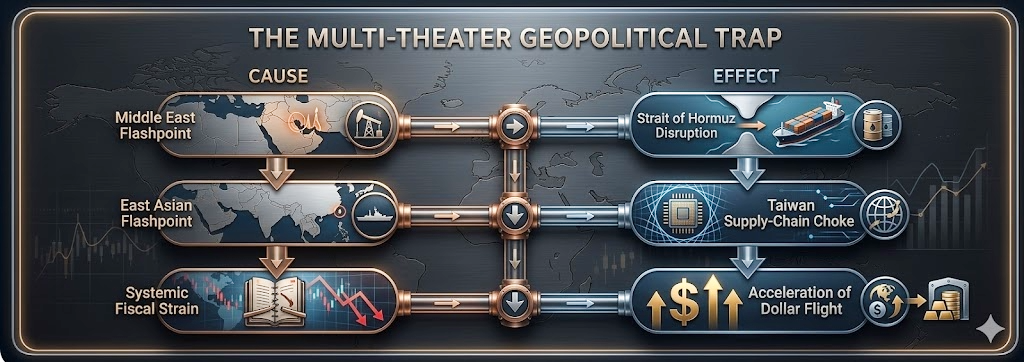
While the underlying fiscal decay of the West provides the structural push for capital migration, a series of compounding geopolitical flashpoints are actively accelerating the fracturing of the US dollar's global dominance. The historical premium of the greenback was built on a simple premise: absolute geopolitical security and the enforcement of unhindered global maritime trade. Today, multi-theater conflicts are stretching this enforcement capability to its absolute limit, signaling to institutional markets that a dollar-pegged monetary layout is built on volatile foundations.
The most immediate friction points are concentrated across critical trade and maritime choke points. The war involving Iran has escalated from localized regional friction into a direct threat to international supply lines. Repeated disruptions and maritime vulnerability within the Strait of Hormuz have sent shockwaves through energy and insurance markets. For global capital, this choke-point volatility exposes a profound vulnerability: when a vehicle currency is tethered to a nation forced into multi-theater defense overstretch, the currency itself absorbs the geopolitical shock.
This friction is severely magnified by East Asian security dynamics. China’s unyielding, aggressive posture regarding Taiwan represents a persistent systemic threat to the global semiconductor supply chain and Western fiscal stability. Any escalation or blockading of the Taiwan Strait threatens to immediately drag the United States into a financially ruinous and logistically complex military entanglement, exposing the dollar to catastrophic inflation and capital controls.
The structural shifts underlying this friction were on full display during the high-stakes state visit of U.S. President Donald Trump to Beijing from May 13–15, 2026. While the summit produced selective, transactional deliverables—including formalized Chinese commitments to purchase $17 billion annually in American agricultural products and an initial procurement of 200 Boeing aircraft (White House Fact Sheet, 2026)—the broader diplomatic readouts revealed a stark geopolitical reality. Beijing remained entirely unyielding on core strategic issues. Chinese leadership offered zero concessions regarding its posturing in the Middle East, signaling that Washington must navigate its regional conflicts without Chinese cooperation, while successfully securing rhetorical acceptance from the U.S. delegation regarding a framework of "constructive strategic stability" (Brookings Institution, 2026).
The takeaway for international asset owners is profound: the summit conclusively demonstrated that the United States no longer possesses the unilateral economic or structural leverage to dictate terms to its primary Eastern competitor. As Washington faces an environment where peer competitors can openly reject its strategic mandates, the risk of aggressive Western regulatory adjustments, sudden asset freezes, and competitive currency devaluations escalates. Private wealth is reacting accordingly, moving away from vulnerable, weaponized fiat systems toward corridors defined by deep liquidity and absolute sovereign neutrality.
Part 4: The BRICS Counter-Weight – Alternative Payment Rails and Multi-Polar Settlement
The structural fragmentation of the Western monetary system is no longer a distant macroeconomic prediction; it is an active, network-driven reality. As traditional fiat frameworks face mounting pressure from Western debt traps and geopolitical conflict, non-Western nations have realized that true sovereign protection requires more than just accumulating physical gold—it demands the construction of an entire parallel financial infrastructure. The global shift away from the US dollar is being driven by the rapid deployment of decentralized payment networks engineered explicitly to bypass Western-dominated messaging systems like SWIFT and eliminate counterparty risk.
This structural counter-weight is anchored by BRICS Pay, a decentralized digital payment platform developed under the oversight of the BRICS Business Council. Inspired by the massive success of real-time domestic rails like Brazil’s PIX and India’s Unified Payments Interface (UPI), BRICS Pay integrates national payment systems across the expanded BRICS+ footprint using advanced blockchain and distributed ledger technology (DLT). By leveraging a Decentralized Cross-Border Messaging System (DCMS), the network enables direct peer-to-peer transactions between member state banks without a single central owner or hub. The DCMS architecture automatically encrypts, signs, and routes transaction messages between participant nodes at speeds reaching 20,000 messages per second, ensuring that international trade settlements remain completely insulated from external sanctions, asset freezes, or unilateral political interference.
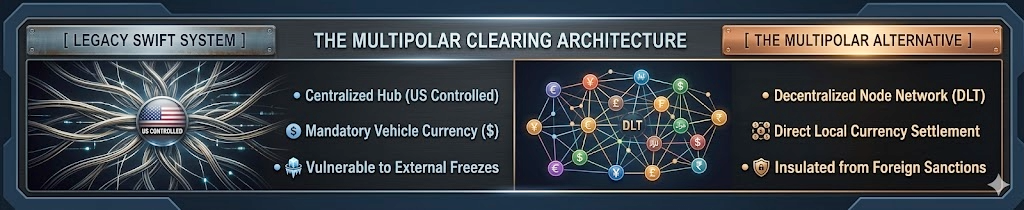
Concurrently, the theoretical concept of Central Bank Digital Currencies (CBDCs) has successfully transitioned into a highly scalable cross-border wholesale reality. The premier engine of this transformation is Project mBridge, a multi-CBDC platform developed jointly by the Bank for International Settlements (BIS) Innovation Hub, the Central Bank of the UAE (CBUAE), the People’s Bank of China, the Hong Kong Monetary Authority, and the Bank of Thailand. Unlike legacy correspondent banking networks that require transactions to clear through intermediary vehicle currencies (primarily the US dollar or Euro) over multiple days, Project mBridge utilizes a unified, single-layer tokenized ledger. This allows participating central banks to issue and settle wholesale international transfers directly against each other in their native digital currencies—such as the digital yuan or the UAE's newly institutionalized Digital Dirham—in under two minutes.
The operational reality of these systems was decisively proven when the UAE Ministry of Finance, alongside the Dubai Department of Finance, successfully executed the UAE's first live government financial transaction using the Digital Dirham over the mBridge platform. This milestone marks a permanent shift in how sovereign capital is managed. Backed by Federal Decree-Law No. 6 of 2025, which formally grants the Digital Dirham the status of legal tender in digital form, the UAE has built a fully functional pipeline that completely detaches wholesale cross-border settlement from traditional Western commercial intermediaries.
For institutional asset owners and corporate family offices, the rise of this parallel financial architecture alters the mechanics of risk management. Wealth structures no longer need to accept the structural currency debasement or political vulnerabilities inherent in traditional Transatlantic banking institutions. By routing capital through corridors integrated with BRICS Pay and mBridge rails, asset owners can settle multi-million-dollar transactions instantly, securely, and directly in local currencies. This architectural shift provides a pristine, non-aligned refuge for international capital, transforming next-generation digital infrastructure into a core pillar of global wealth preservation.
Part 5: The Autonomous Pillars – UAE’s OPEC Exit and India’s Thorium Horizon
While parallel financial messaging infrastructure provides the circulatory system for a multipolar global order, capital ultimately demands destination networks backed by absolute resource and energy sovereignty. Overleveraged Western nations remain structurally vulnerable to external commodity shocks and political blackmail due to their fragile, import-dependent supply chains. In stark contrast, the two core nodes of the UAE-India corridor have executed deliberate, long-term policy adjustments designed to permanently insulate their domestic macro-environments. By severing ties with legacy energy cartels and pioneering revolutionary paths toward absolute domestic power independence, both nations have established themselves as self-sustaining, autonomous safe havens.
The most explosive manifestation of this sovereign pivot occurred on May 1, 2026, when the United Arab Emirates officially withdrew from the Organization of Petroleum Exporting Countries (OPEC) (Invesco Asset Management Report, 2026). Breaking nearly six decades of membership, Abu Dhabi’s unilateral exit—executed without consulting Saudi Arabia—signaled a fundamental refusal to let its economic destiny be micromanaged by a foreign committee (Veersant Strategic Analysis, 2026).
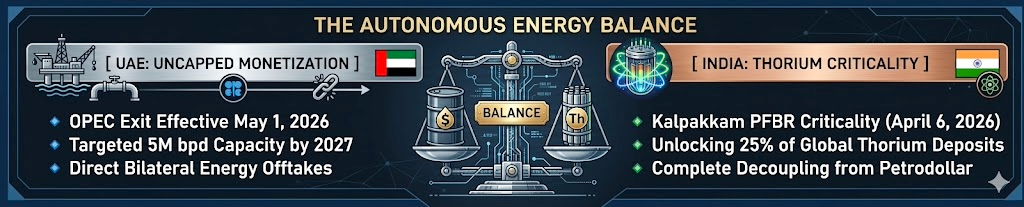
For years, the UAE’s true economic capacity was restricted by Saudi-led production quotas, forcing the state to suppress its 4.85 million barrels per day (mb/d) capacity down to a capped 3.2 mb/d ceiling. By exiting the cartel, the UAE has reclaimed full control over its natural resources, clearing the path to expand production toward its 5.0 million barrels per day capacity target by 2027, backed by a $150 billion ADNOC capital deployment campaign (OPEC Annual Statistics Bulletin, 2026). Free from OPEC production ceilings, the UAE can now bypass Western reference baskets to negotiate direct, long-term energy offtake agreements with primary importing states like China and India, funneling these uncapped revenues directly into the domestic expansion of its premium common-law financial hubs.
Concurrently, India has achieved a historic milestone that permanently rewrites its long-term macroeconomic trajectory. On April 6, 2026, India’s indigenously designed and built 500 MWe Prototype Fast Breeder Reactor (PFBR) at Kalpakkam successfully attained its first criticality, initiating a sustained, self-sustaining nuclear chain reaction (Press Information Bureau, Govt of India, 2026). Managed by BHAVINI at the Kalpakkam Nuclear Complex, this breakthrough marks India’s formal entry into the critical Second Stage of its three-stage nuclear power program.
The structural significance of Kalpakkam cannot be overstated: fast breeder reactors produce more fissile material than they consume, acting as the mandatory technological bridge to transmute Thorium-232 into Uranium-233. This breakthrough allows India to begin harnessing its colossal domestic thorium reserves, which represent nearly 25% of total global deposits (Department of Atomic Energy, 2026).
By scaling a thorium-based closed fuel cycle under its freshly enacted SHANTI Act of 2025 and targeting a 100 GW nuclear capacity by 2047, India is systematically charting a definitive course toward total energy independence. This technological leap permanently decouples the subcontinent from its historically volatile reliance on foreign petroleum imports, which currently drain the national ledger to cover roughly 85% of its crude oil requirements (IEA Oil Market Report, 2026). As thorium replaces imported oil as the primary engine of India's grid, the nation's current account deficit shrinks, insulating the domestic economy from global energy inflation and systematically breaking the petrodollar’s structural hold over Indian trade. For global capital allocators, this dual-node energy sovereignty provides the ultimate macro hedge: an interconnected ecosystem where the capital repository (the UAE) and the high-growth industrial engine (India) are completely insulated from Western fiscal decay and geopolitical overstretch.
Part 6: The Nexus as a Safe Haven – Unlocking the UAE-India Institutional Corridor
The convergence of Western fiscal degradation and the creation of decentralized, parallel financial systems has fundamentally redrawn the global map of capital routing. Private family offices, institutional asset managers, and sovereign wealth are no longer merely diversifying their portfolios; they are actively migrating their legal headquarters. This capital requires an institutional pipeline that connects an ultra-secure, tax-efficient structuring repository with a high-yielding, fundamentally insulated macroeconomic growth engine. This exact infrastructure is fulfilled by the structural symbiosis of the UAE-India Geopolitical Corridor.
The entry point of this pipeline relies on the highly sophisticated, common-law legal frameworks of the UAE's premier financial jurisdictions: the Abu Dhabi Global Market (ADGM) and the Dubai International Financial Centre (DIFC). Operating as independent, English-language common-law enclaves completely insulated from the civil law systems of the wider region, these international financial centers (IFCs) offer global capital absolute legal predictability, robust shareholder protections, and sophisticated asset-segregation tools.
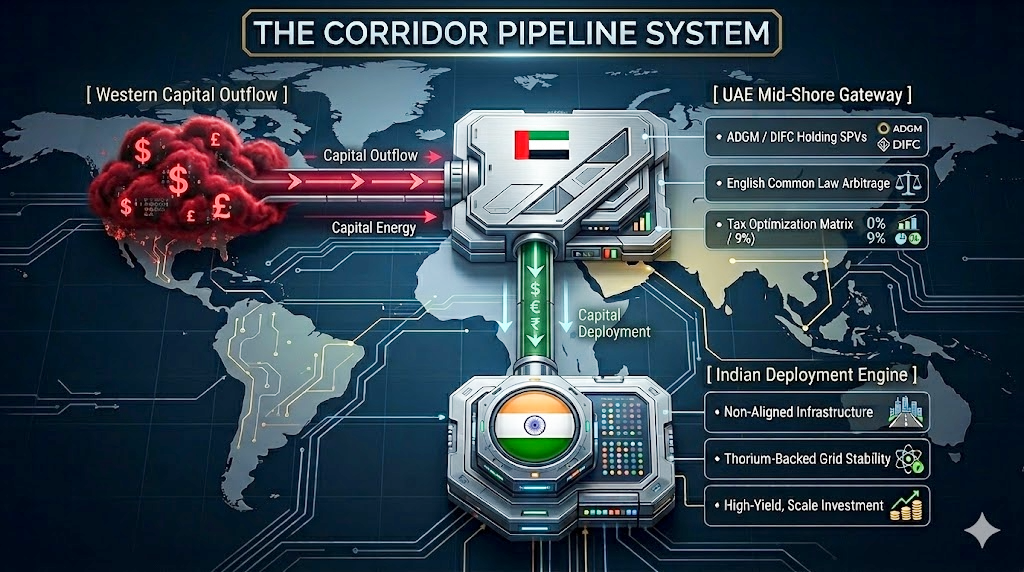
The preferred operational vehicle for global asset migration within this gateway is the ADGM Special Purpose Vehicle (SPV) and the DIFC Prescribed Company. These passive holding structures allow investors to isolate financial and legal liabilities, shield global assets from foreign judicial overreach, and structure complex capital waterfalls. These vehicles have become even more powerful following the landmark execution of Federal Decree-Law No. 20 of 2025 (effective January 1, 2026), which overhauled the UAE Commercial Companies Law. The 2026 framework introduces formal corporate mobility, permitting international entities to seamlessly re-domicile their legal seats from volatile offshore islands directly into the UAE mainland or its free zones without losing their historic legal personality, contracts, or asset continuity. When integrated with the UAE's modernized Corporate Tax matrix—which preserves a 0% rate on Qualifying Free Zone Income under Ministerial Decision 229 of 2025—these structures allow institutional wealth to achieve unparalleled tax efficiency while maintaining pristine global compliance substance.
Once capital is securely consolidated within the UAE’s common-law holding layer, it is systematically directed down a secure bilateral conduit into the ultimate industrial landing pad: India's hyper-growth economic engine.
This is not a destination for speculative paper assets; it is an engine for large-scale, long-term capital deployment. Backed by its strict geopolitical neutrality and structural immunity from Western banking halts, India offers a highly stable environment for core infrastructure investments. Migrating wealth flows cleanly out of UAE SPVs directly into India's critical sectors—including national logistics networks, digital highways, and the rapidly scaling green energy grid powered by the landmark thorium breakthroughs at Kalpakkam. Because India’s long-term macro trajectory is no longer weighed down by a vulnerable current account deficit or tied to the erratic pricing of the petrodollar loop, these underlying projects deliver stable, compounding, inflation-hedged yields. The UAE-India axis thus functions as a complete safe-haven loop: the UAE provides the asset protection and corporate structuring canopy, while India supplies the unyielding, real-world economic growth required to protect and grow global generational wealth.
Part 7: The Proactive Paradigm – Strategic Takeaways for Private Wealth Preservation
The architectural shift of global capital from volatile Western systems into the UAE-India corridor completely changes the role of cross-border wealth management. In this parallel financial landscape, compliance is no longer a reactive back-office task; it is a core mechanism of capital preservation. When assets are structured across a corridor that bypasses traditional Western networks, the primary threat to wealth is no longer market volatility, but structural mismatch—where an asset layout built improperly in one jurisdiction accidentally triggers severe penalties in another. Protecting global wealth requires a proactive approach to regulatory engineering, designed to perfectly bridge the UAE's modernized corporate substance rules with India's strict capital control frameworks.
The foundational layer of this strategy requires flawless execution within the UAE corporate ecosystem. The historical myth that operating within a UAE Free Zone guarantees an automatic exemption from taxation has been permanently erased by the implementation of the Federal Corporate Tax framework (Federal Decree-Law No. 47 of 2022). Under updated tax guidelines, Free Zone entities are recognized as resident taxable persons, facing a standard 9% corporate tax rate on taxable income exceeding AED 375,000 (ClearTax, 2026).
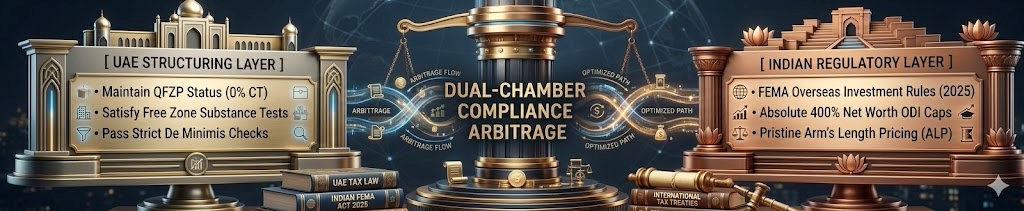
To legally secure a 0% tax rate on Qualifying Income, a corporate entity must strictly fulfill the requirements to be certified as a Qualifying Free Zone Person (QFZP) under Cabinet Decision 100 of 2023, read alongside the expanded activity lists formalized in Ministerial Decision 229 of 2025 (Sarmat CT Guide, 2026). This status demands absolute operational transparency:
- The Substance Mandate: The structure must maintain adequate physical substance inside its designated free zone, demonstrating sufficient operating expenditures, local physical infrastructure, and adequate numbers of qualified, locally resident employees.
- The De Minimis Filter: Entities must continuously monitor their revenue mix; if non-qualifying or excluded income crosses the de minimis threshold—the lower of 5% of total revenue or AED 5 million—the entity loses its QFZP status entirely, subjecting its total taxable income to the flat 9% rate for that period and the subsequent four fiscal years (Acclime Corporate Tax Review, 2026).
This UAE corporate layer must then be precisely balanced against India’s strict, rule-based outbound capital frameworks. For cross-border promoters and corporate allocators, every single dollar routed from India into a UAE holding vehicle must perfectly align with the Foreign Exchange Management (Overseas Investment) Rules, 2025, and the freshly enforced FEMA (Guarantees) Regulations, 2026 (RBI Notification, 2026).
Under the revised 2025/2026 Overseas Direct Investment (ODI) framework, an Indian entity's total financial commitment—comprising equity injections, extended corporate debt, and cross-border guarantees—is capped at a maximum of 400% of the Indian entity's net worth as calculated on its last audited balance sheet (Razorpay FEMA Guide, 2026). Any transactional delay or misreporting of Form ODI to an Authorized Dealer (AD) Category-I bank immediately triggers Late Submission Fees calculated at a baseline of ₹7,500 plus 0.025% of the total transaction value per year of delay (AccountX Compliance Manual, 2026). Furthermore, under the strict anti-round-tripping mandates of the two-layer restriction, individual Indian investors remitting capital under the USD 250,000 Liberalized Remittance Scheme (LRS) window are legally barred from creating multi-tiered, step-down corporate subsidiaries if they exercise direct control over the primary foreign operating entity.
Ultimately, successful cross-border asset protection relies on Confluence Engineering—ensuring that corporate transfer pricing structures satisfy both jurisdictions simultaneously. All inter-company transactions, management fees, and intellectual property licensing agreements between an Indian promoter group and a UAE single-family office or SPV must reflect strict Arm's Length Pricing (ALP) backed by internationally accepted valuation methodologies.
By building corporate vehicles that satisfy the UAE's strict economic substance and de minimis tests while remaining perfectly within the RBI's 400% corporate net worth caps and guarantee frameworks, asset owners construct a bulletproof financial bunker. In an era defined by Western debt decay, fracturing alliances, and weaponized financial messaging networks, this dual-compliant architecture transforms the UAE-India corridor from a standard corporate route into the ultimate safe-haven sanctuary for global wealth preservation.
🏛️ Summary, Conclusions, and Key Takeaways
The tectonic shifts reshaping the global financial landscape are neither temporary nor cyclical; they are structural signs of a permanent transition toward a multipolar world order. When the standard low-risk anchors of Western finance become central nodes in predatory debt loops, and traditional payment rails are weaponized for political coercion, the fundamental definition of wealth preservation changes. The silent signal sent by global central banks—accumulating physical bullion while maintaining public diplomatic compliance—underscores a profound reality: institutional safe havens have moved.
The UAE-India Geopolitical Axis stands as the premier institutional sanctuary of this new epoch. By pairing the sophisticated, common-law legal protections of the UAE’s financial free zones with India's self-sustaining, thorium-powered infrastructure engine, this corridor has decoupled from Western fiscal vulnerabilities. It offers a secure ecosystem where capital is protected from currency debasement, asset freezes, and supply-chain disruptions.
📋 Strategic Takeaways for Family Offices and HNWIs
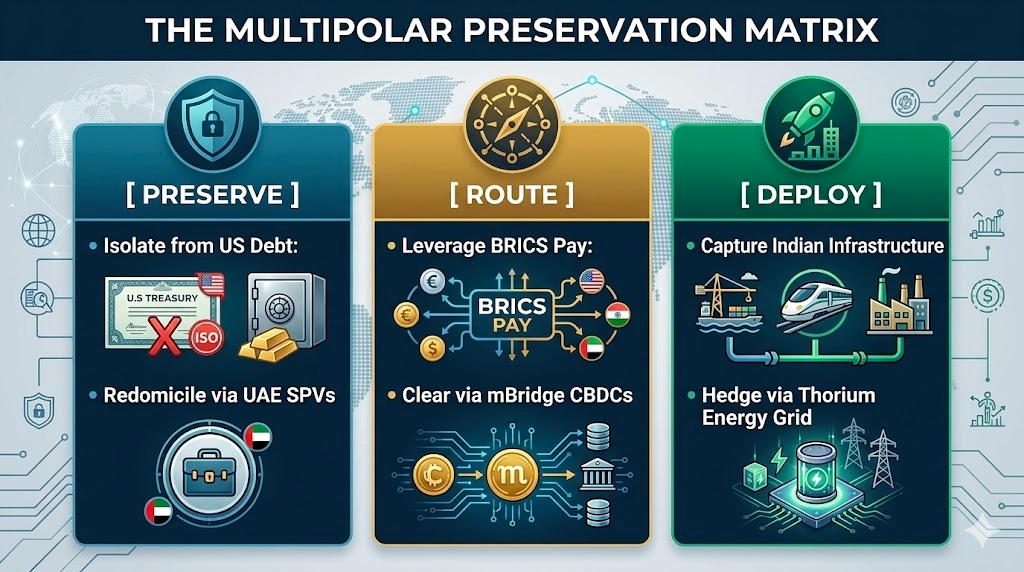
To insulate multi-generational wealth from this global realignment, asset owners and corporate allocators must execute a proactive, dual-chamber strategy:
- Execute Structural Redomiciliation: Proactively utilize the enhanced corporate mobility frameworks of ADGM and DIFC to transition vulnerable holding structures from Western or legacy offshore jurisdictions into insulated common-law SPVs, shielding global assets from foreign judicial overreach.
- Secure Qualifying Corporate Substance: Ensure all UAE corporate vehicles strictly satisfy the updated QFZP guidelines under Ministerial Decision 229 of 2025. Maintain adequate local operational expenditure, physical infrastructure, and qualified staff to legally preserve the 0% tax rate on qualifying income while crossing strict de minimis filters.
- Optimize Within FEMA and ODI Guardrails: Align all outbound capital routing from the Indian subcontinent with the strict 400% net worth limits dictated by the Foreign Exchange Management (Overseas Investment) Rules. Ensure pristine paper trails and compliance documentation to completely eliminate the risk of late submission fees or round-tripping violations.
- Implement Arm's Length Confluence Engineering: Structure all inter-company transactions, management fees, and intellectual property transfers between Indian promoter operations and UAE family offices using bulletproof Arm's Length Pricing (ALP) methodologies. This dual-compliant positioning ensures the wealth structure satisfies both the Indian Income Tax Department and the UAE Federal Tax Authority simultaneously.
Ultimately, in this fragmented macroeconomic environment, compliance can no longer be viewed as an administrative burden. For those who engineer their structures proactively, fluid cross-border compliance becomes the ultimate structural shield, ensuring that capital not only survives the fracturing of the old world order but thrives within the sanctuary of the new.
Disclaimer
The core concepts, intellectual frameworks, and primary conclusions presented in this post—whether exploring macroeconomics, technology, governance, or philosophical inquiry—are the result of extensive synthesis, wide-ranging study, and the author's personal observations of global developments and literature. In alignment with modern digital workflows, advanced generative AI (Gemini) is utilized as a collaborative tool to assist in refining prose, structuring editorial layouts, and drafting supporting conceptual imagery. All final content is personally curated, reviewed, and approved by the author.