Unlocking Brahman: The Illusion of the World and the Ultimate Lucid Dream
This blog post explores the concept of Brahman through the classical Vedantic “Dream Analogy,” illustrating how our universe and individual identities are projections of a single, absolute consciousness. It highlights the subtle spiritual trap of partial realization, where an individual seeks to manipulate reality like a lucid dreamer rather than detach from it. Ultimate liberation (Moksha) is achieved only when the urge to control is dropped entirely, allowing the seeker to shift from an active controller to a peaceful witness who realizes that all is Brahman.
Overview
Explaining the realization of Brahman (the Ultimate Reality or Absolute Consciousness) is one of the greatest challenges in spiritual philosophy. By its very nature, Brahman isn’t something you can just intellectually grasp—it is something you must realize and experience firsthand. However, whenever I try to convey this profound concept, I find there is one classical method that brings us closest to understanding it: The Dream Analogy (Svapna Drishtanta).
1. The Core Foundation: The Weaver of the Dream
Imagine you are fast asleep, deep in a dream.
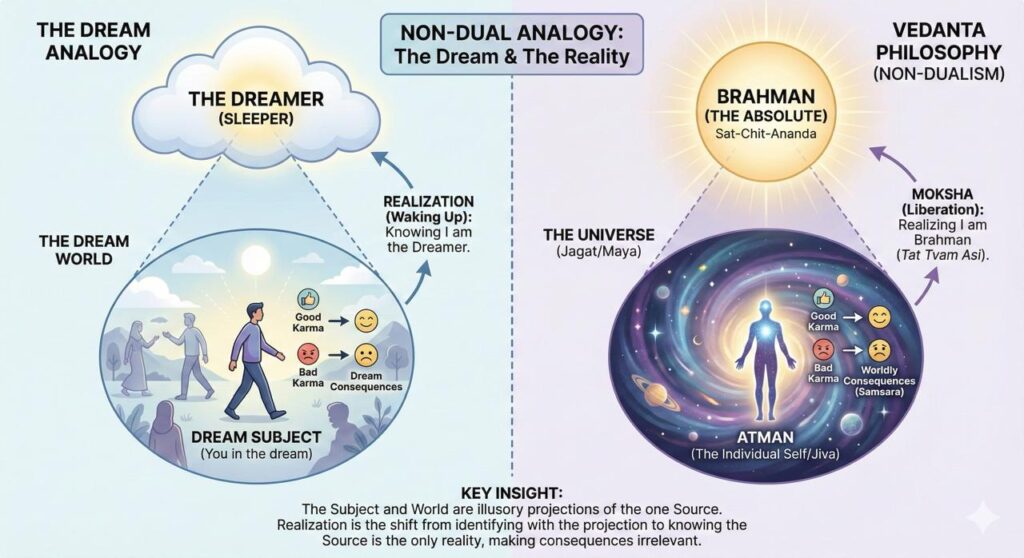
In this dream, you see yourself—the Subject—navigating an incredibly elaborate world. You go about the various acts of life, experiencing both the good and the bad. You notice a strict law of cause and effect: when the Subject performs a good deed, it yields a positive outcome; when they engage in something immoral, it results in a negative consequence. This is the law of Karma playing out within the dream.
But look closer at this entire setup. Every person around the Subject, the events taking place, and the very universe they are walking through are entirely creations of the dream.
In this context, the person who is asleep and dreaming is Brahman. The Subject, the people, and the sprawling universe within the dream are nothing but Brahman’s creation. Because of this, if you try to draw a hard line between Brahman, the Subject, and the dream world, you’ll find they are completely indistinguishable. They are made of the exact same fabric—the consciousness of the dreamer.
This is our reality. We, along with the vast universe around us, are nothing but Brahman ($Sarvam\ Khalvidam\ Brahma$—All this is verily Brahman).
2. The Awakening: Becoming a Lucid Dreamer
Now, imagine a shift happens within your dream. You suddenly achieve a state of lucid dreaming—you realize that you are dreaming.
In that precise moment of realization, you understand that you have the power to control and decide the outcome of any action as you desire. Because it is your dream, you master all aspects of it. Suddenly, the strict consequences of your dream-actions no longer carry weight. You know this current dream state is merely temporary, and the moment it ends, you will return to the awake status. That awake status is the realized state.
As soon as you recognize the temporary nature of the dream, the consequences within it become entirely irrelevant. Even while still functioning inside the dream, you possess the quiet confidence that the Subject and Brahman will fully merge the moment the sleep state is over.
3. The Trap of Control: The Post-Realization Struggle
However, true spiritual realization is rarely a sudden, clean break. There is a deep, realistic layer to this evolution: The Struggle of Control.
When the Subject first realizes they are dreaming, they attain the power to manipulate the dream. Material desires still inflict the Subject, tempting them to use this newfound “realization” to fix the dream world—to make themselves fly, build palaces, or alter outcomes.
This is the state of Partial Realization, and it represents a subtle trap: The Spiritual Ego.
Even after a glimpse of the truth, the ego is incredibly clever. It goes from saying “I am a victim of the world” to saying “I am the God of this world.” This constant fluctuation between the dream world and the fully realized state represents a profound psychological battle. The old mental habits and desires (Vasanas) are still firing.
Like an electric fan that has been unplugged but continues to spin due to past momentum (Prarabdha Karma), the Subject still feels compelled to “fix” the dream, even though they know it isn’t ultimately real.
4. The Final Shift: Attaining True Moksha
Ultimately, the Subject undergoes a final, supreme transformation. The desire to control the dream is entirely overcome, and they dissolve into the state of the pure Observer (Sakshi Bhava).
Why does the desire to control vanish?
- Futility: If the dream world is an illusion, trying to “fix” it is like trying to iron a shirt that only exists on a movie screen.
- Completeness ($Purnatvam$): Control implies preference—it means you think changing outcome X to outcome Y will make you happier. But a fully realized being knows they are the Infinite Bliss of Brahman. Changing the dream adds nothing to them; a nightmare subtracts nothing from them.
| Stage of Consciousness | The Subject’s View | Relationship to the Dream | The Spiritual State |
|---|---|---|---|
| 1. Bondage | “I am only this body.” | Victim: The world happens to me. | The Sleeper trapped in a nightmare. |
| 2. The Struggle | “I am the Master of the dream.” | Controller: I will manipulate this world. | The Lucid Dreamer caught in spiritual ego. |
| 3. Liberation | “I am Brahman.” | Witness: I watch the world happen. | The Awakened One who lets the dream fade. |
The second the Subject lets go of the urge to control, the duality collapses. The Subject realizes that the universe and everyone in it are nothing but expressions of Brahman—and that Brahman is, ultimately, themselves.
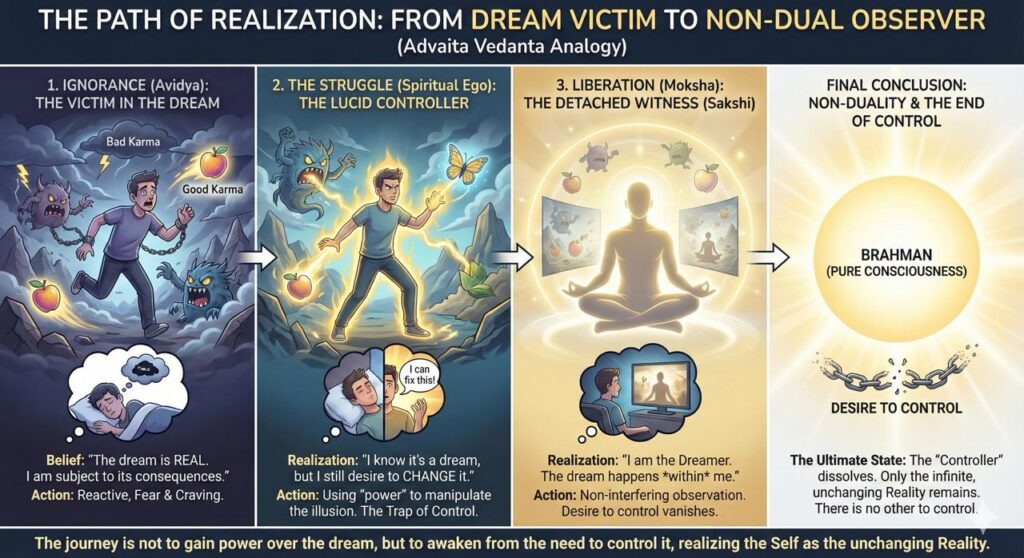
Upon this grand realization, the actions of the Subject no longer have a binding effect, and true Moksha (liberation) is attained. The chaotic events of the dream world can no longer disrupt their inner peace. They naturally begin to view the world through the serene lens of the Divine Creator, resting in the absolute truth: Brahman is all, and all is Brahman.
Disclaimer
The core concepts, intellectual frameworks, and primary conclusions presented in this post—whether exploring macroeconomics, technology, governance, or philosophical inquiry—are the result of extensive synthesis, wide-ranging study, and the author’s personal observations of global developments and literature. In alignment with modern digital workflows, advanced generative AI (Gemini) is utilized as a collaborative tool to assist in refining prose, structuring editorial layouts, and drafting supporting conceptual imagery. All final content is personally curated, reviewed, and approved by the author.